
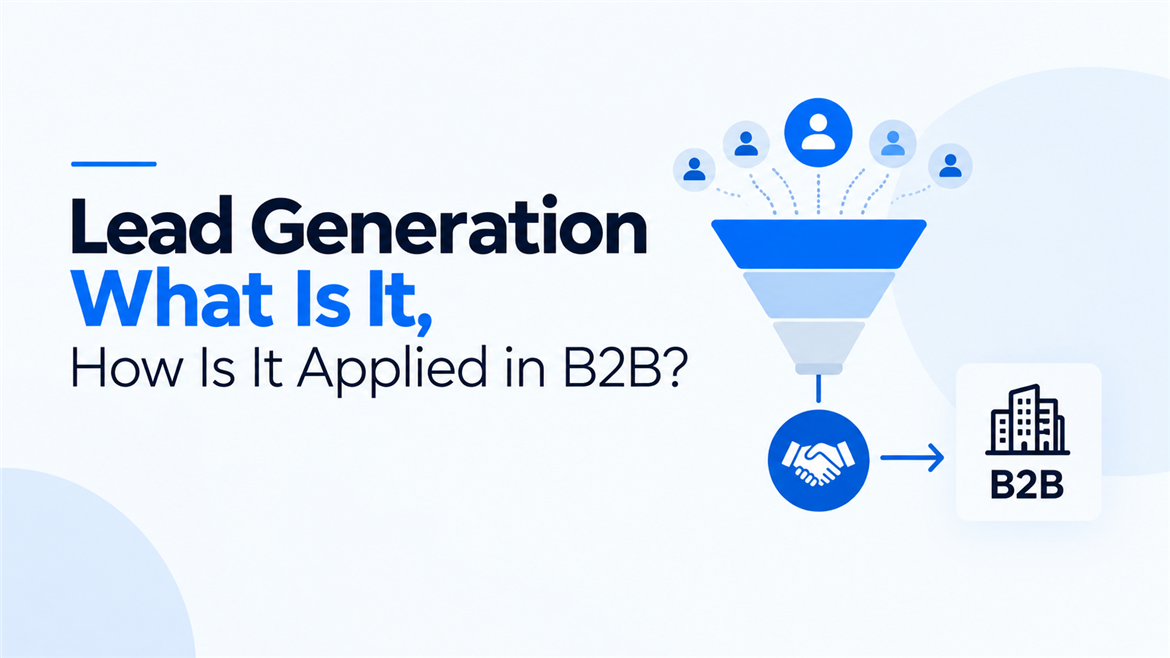
Anyone who has worked with a sales team at a B2B company has heard this sentence: "We need high-quality leads; we care about quality, not quantity." Lead generation is exactly the answer to this need. In simple terms, lead generation is the process of identifying people or companies that may be interested in a brand's product or service and obtaining their contact information and interest. In other words, it is not about shouting at a random crowd; it is about getting the right person to raise their hand.
On the B2B side, things are a little more complicated. You are not dealing with a single consumer, but often with a purchasing committee, several decision-makers, and a lengthy evaluation process. That is why companies that structure lead generation correctly provide their sales teams with a ready and intent-driven list. Those that fail to do so spend their time making cold calls. In this article, I will explain both the essence of the concept and how it is applied in real-world B2B scenarios, drawing on examples I have encountered in nearly a decade of working in digital marketing.
What Is Lead Generation?
In its simplest form, lead generation is the process of collecting a potential customer's name, contact information, and area of interest within a system. Someone filling out a form on your website, leaving their email address to download an e-book, or submitting a demo request are all moments when a lead is generated. That person is no longer an anonymous visitor but a real opportunity you can engage with.
It is useful to clarify the word "lead" here. It generally refers to a potential customer, but not every lead has the same value. Some people may fill out a form simply out of curiosity, while others may already have a budget and be ready to buy. The purpose of lead generation is not only to collect these names but also to establish a system that allows you to understand how warm each lead is. Without such a system, you may have a list of thousands of people, yet none of them will be useful.
This is also where the difference from traditional advertising becomes clear. Traditional advertising makes a brand visible and builds awareness, but it does not leave you with tangible contact data. Lead generation, on the other hand, produces measurable results. You can see in numbers how many people arrived, how many submitted their information, and how many became customers. That is one of my favorite aspects of digital marketing: instead of guessing, you can look at the data.
Why Does Lead Generation Work Differently in B2B?
On the B2C side, someone likes a pair of shoes, adds them to the cart, pays, and the process is complete. Sometimes the entire journey takes only a few minutes. In B2B, that kind of speed is rarely possible. If a company is purchasing enterprise software, the purchasing manager, IT manager, finance department, and general manager may all be involved in the decision. In other words, convincing one person is not enough; you need to convince an entire table.
This structure fundamentally changes the lead generation strategy. In B2B, the buying cycle can last for weeks or even months. During the period between the first contact and signing the agreement, you need to remain top of mind, build trust, and deliver the right content at the right time. That is why B2B lead generation is much more like building a relationship than using a sell-and-close-immediately mentality. Many brands that act too quickly lose opportunities by putting sales pressure on companies that are not yet ready.
The second major difference is the narrowness of the target audience. In B2C, you may be able to reach millions of people, whereas in B2B there may be only three hundred companies in all of Türkiye that could potentially buy your product. In such a scenario, every lead is extremely valuable, and you cannot afford to waste any of them. Channels with strong targeting capabilities are preferred to reach the right companies, and LinkedIn plays a major role here. The campaigns we run through LinkedIn advertising make it possible to reach decision-makers in the right positions directly.
Finally, logic tends to outweigh emotion in B2B, but completely ignoring emotion would also be a mistake. Corporate buyers are still human beings, and they want to work with brands they trust, that communicate clearly, and that take their work seriously. Numbers, references, and clear solutions matter; however, no proposal will fully resonate unless you can make the other side feel, "This company really understands my problem."
How to Build a B2B Lead Generation Process Step by Step
Building a lead generation system is essentially like building a funnel. At the top, there is a broad audience; as you move downward, the audience becomes narrower while intent becomes stronger. You perform a different task at each layer of this funnel, and if you skip layers, the system collapses. The most common mistake I see in practice is companies trying to start directly from the bottom, attempting to sell before anyone even knows the brand.
The first stage is awareness. The goal here is to attract the attention of companies that may need your product but have not yet heard of it. This is where blog content, search engine visibility, and social media come into play. Without a strong content strategy, this layer remains empty and no one flows into the rest of the funnel. The second stage is interest: the person has now noticed you and wants to learn more. The third stage is evaluation, where the company begins comparing you with your competitors.
To make the process more concrete, I can summarize a typical B2B lead generation flow as follows:
- Define the target audience: Clarify which industry, company size, and job position represent your ideal customer.
- Select traffic sources: Choose SEO, advertising, LinkedIn, or email depending on where your audience is active.
- Create a value proposition: Offer an e-book, report, webinar, or free analysis in exchange for contact information.
- Landing page and form: This is where interest turns into information, so it should be simple and persuasive.
- Lead scoring: Score incoming leads according to their level of interest and suitability.
- Sales handoff: Transfer sufficiently qualified leads to the sales team at the right time.
Once you build this flow, the work is not finished; that is actually where it begins. You measure every step, identify bottlenecks, and continuously improve the process. For example, if many people see the form but few complete it, the problem is likely on the landing page. If you receive many leads but they do not convert into sales, your targeting is probably wrong. Lead generation should therefore not be treated like a machine that is set up once and forgotten, but as a living system that requires constant adjustment.
The Most Commonly Used Lead Generation Channels in B2B
Channel selection is one of the factors that determines the fate of lead generation. No matter how much budget you spend on the wrong channel, the result will be disappointing, while even a small budget on the right channel can deliver surprising efficiency. The golden rule is simple: be where your target audience spends its time. The right channel for an industrial machinery manufacturer will not necessarily be the same as the right channel for a cloud software company.
Based on years of experience, I can say that relying on a single channel is risky. Google may release an algorithm update, LinkedIn costs may increase, or a platform may unexpectedly lose reach. That is why a healthy B2B strategy usually combines several channels. Below are the channels that have produced the strongest results for us in B2B and what they are used for:
- LinkedIn: Thanks to its ability to target users by job title, industry, and company, it is one of the most important B2B platforms. If you want to reach decision-makers directly, it is indispensable.
- Google Ads: It captures companies actively searching for a solution and therefore showing strong intent. Appearing for the right keywords through Google Ads consulting can bring in leads that are ready to buy.
- SEO and organic search: In the long term, it is one of the lowest-cost sources of leads. A properly structured SEO strategy can keep filling the top of your funnel even while you sleep.
- Content marketing: Guides, case studies, and reports both build trust and collect contact information in exchange for valuable information.
- Email marketing: It is one of the most cost-effective ways to nurture your existing list and re-engage leads that have gone cold.
- Website and conversion points: A well-designed website is the main stage where traffic from all these channels is converted into leads.
None of these channels is magical on its own. The key is to understand which stage of the funnel each channel feeds and connect these pieces together. For example, SEO creates awareness, LinkedIn develops interest, Google Ads captures high-intent prospects, and email persuades those who are still undecided. When this orchestra plays in harmony, lead generation can become a genuinely profitable system.
MQL and SQL: Not Every Lead Is the Same
This is one of the topics sales and marketing teams argue about most. Marketing says, "We sent you lots of leads," while sales responds, "None of them were useful." The reason for this vicious cycle is usually the absence of a shared definition. MQL and SQL concepts exist precisely to resolve this problem.
An MQL, or marketing qualified lead, is someone who has shown interest in your product but is not yet ready to buy. They may have downloaded your e-book or read several of your blog posts. They are interested, but they still need to be nurtured. An SQL, on the other hand, is a sales qualified lead; this person has requested a demo, asked for pricing, or clearly demonstrated purchase intent. If you send an MQL to the sales team without understanding the difference, you waste the salesperson's time and risk losing the potential customer by applying sales pressure too early.
Let me give you a concrete example. While working with an accounting software company, they were sending everyone who downloaded a "free e-book" directly to the sales team. Sales representatives would call them, only to hear, "I was just curious." Both sides were becoming frustrated. After implementing a simple scoring system and defining only those who visited the pricing page or submitted the demo form as SQLs, the sales team's closing rate increased noticeably. The only thing that changed was identifying the right lead at the right time.
For this distinction to work properly, the two teams need to sit at the same table and agree on a shared definition. Which behaviors qualify as an MQL and which ones promote a lead to SQL status should be documented. Otherwise, everyone interprets the criteria differently, and the old "there are no quality leads" argument continues forever.
The Role of Content and Landing Pages in Lead Generation
The success of a lead generation campaign is often determined not by the advertising budget but by the page the advertisement sends people to. If you create an excellent ad and send people to a careless landing page, it is like pouring water into a bucket with a hole in it. Traffic arrives but does not convert into leads, and while you question the cost, the real problem is sitting right in front of you.
A good landing page focuses on a single task. It does not contain distracting menus, irrelevant links, or ten different buttons. The moment someone enters the page, they should understand within seconds what is being offered, how it benefits them, and what they need to do next. Much of this clarity comes from the copy. A well-structured headline and persuasive text can sometimes double the conversion rate. That is why copywriting should never be treated as an insignificant detail.
Content is the fuel that feeds the upper part of the funnel. Before people trust a brand, they often want to trust its knowledge. An industry guide, a useful checklist, or a report based on real data can position your brand as an authority while also providing an elegant way to collect contact information in exchange for value. People may not want to click a banner, but they are often willing to provide their email address for a genuinely useful resource.
It is a major mistake to consider these two separately. Content creates interest, while the landing page turns that interest into a lead. If one is strong and the other is weak, the system is still incomplete. In the most efficient campaigns, the content and conversion page tell the same story and guide the visitor through a single flow from first contact to form submission. For those who want to take conversions further, conversion rate optimization is a specialized discipline in its own right and can help you generate far more leads from your existing traffic.
Metrics That Measure Lead Generation Success
You cannot manage what you cannot measure. The phrase may be a cliché, but it is absolutely true for lead generation. Many companies focus only on the question, "How many leads did we get?" and that number alone can be misleading. If a thousand leads arrive and none of them converts into a sale, that thousand has little value. The real issue is knowing which metric tells you the truth.
For a healthy evaluation, you need to look at several complementary metrics at the same time. Falling in love with a single number can cause you to miss the bigger picture. Below are the key metrics you should regularly monitor in B2B lead generation and what they tell you:
- Conversion rate: Shows what percentage of page visitors become leads. This is where you can see the real performance of your channels and pages.
- Cost per lead (CPL): Shows how much you spend to acquire one potential customer. It is one of the clearest ways to measure budget efficiency.
- MQL-to-SQL conversion rate: Shows how many of the leads generated by marketing actually move closer to a sale. If the rate is low, either the targeting or the content is likely wrong.
- Closing rate: Shows what percentage of SQLs become actual customers. It reflects the alignment between sales and marketing.
- Customer acquisition cost (CAC): The total cost of acquiring one customer and a metric that directly affects profitability.
- Return on investment (ROI): Shows the return generated by the money you spend and whether the overall effort is worthwhile.
Monitoring these metrics regularly moves lead generation away from emotional assumptions and onto solid ground. ROI, in particular, is always one of the most important topics in B2B because both corporate buyers and managers ultimately want an answer to the question, "What did this generate for us?" If you are curious about how this calculation is made, I recommend reading our detailed article on calculating ROI in digital marketing.
Common Mistakes in B2B Lead Generation
After managing so many campaigns, I have noticed that companies often fall into the same traps. What these mistakes have in common is that they all seem logical at first glance but undermine the system in the long run. The most common mistake is prioritizing quantity over quality. Saying, "We generated two thousand leads this month," may sound impressive, but if only five of them are genuine buyers, that number is merely an illusion that inflates the report.
The second common mistake is failing to follow up with incoming leads. A company fills out a form, nobody responds for days, and then someone says, "The leads were bad." In B2B, however, timing is critical. Someone may have filled out the form precisely when they were considering your company; two days later, that interest may have cooled and shifted to a competitor. The speed of the first response often determines the fate of the sale. Teams that respond quickly generally have noticeably higher closing rates than teams that respond late.
The third problem is the disconnect between sales and marketing. Marketing focuses on its own goals, sales focuses on its own goals, and the two teams do not communicate. In such a structure, marketing generates the wrong leads, sales wastes them, and both sides blame each other. In reality, these two teams are rowing the same boat. No lead generation system can be sustainable without shared goals, shared definitions, and regular communication. For companies that need an external perspective on this process, we frequently help redesign these workflows through our business consulting services.
One final mistake is impatience. B2B results do not usually arrive within a week. A process that starts at the top of the funnel and flows all the way to the sale needs time to mature. Companies that abandon the entire system because they do not see the expected numbers in the first month and then try something completely different the next month never achieve consistency. In short, lead generation is a marathon, not a hundred-meter sprint; the best results come to those who are patient.
In Summary
Lead generation is the backbone of systematic growth in B2B. You define the right audience, meet them through the right channels, turn interest into information, and information into sales. The principle is actually simple: focus not on random crowds, but on companies that could genuinely work with you. Once you establish this focus, your sales team no longer exhausts itself with cold calls and instead receives qualified opportunities that are ready and interested.
If you also want to build a sustainable flow of potential customers for your company, the healthiest approach is to plan the entire process from beginning to end. Every link in the chain, from channel selection and landing page structure to measurement and sales handoff, needs to be in the right place. If you need a partner at this point, simply contact us and we can structure the rest together.


Do Comment