
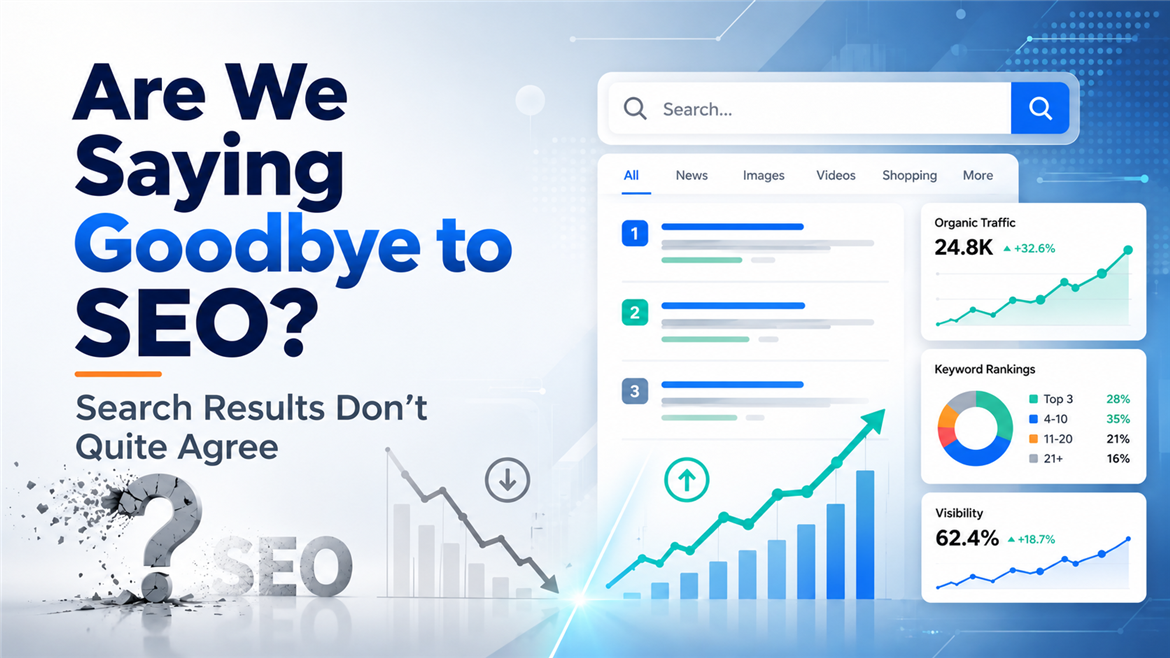
"SEO is dead."
Do you remember when you first heard this sentence? I don't, because it was such a long time ago. SEO was dead when social media took off. SEO died again when voice search arrived. It died once more when Google increased zero-click searches. And now, in the age of ChatGPT, Gemini, and Perplexity, SEO's funeral is being held yet again.
But here's the interesting part: even the search engines sending out invitations to this funeral don't agree. Google still processes billions of queries every day, AI assistants still crawl content on the web while generating answers, and the method they use to find that content will sound familiar: search.
So SEO isn't dead. But let's be honest, it's not what it used to be either. In this article, we'll discuss why the "SEO is over" narrative is misleading, how GEO (Generative Engine Optimization) actually builds on SEO, and what you need to do in this new era, using real data and real examples.
First, Let's Understand the Reason for the Panic: What Do the Numbers Say?
It would be unfair to say that the panic is completely unfounded. There really is a major shift taking place:
As of February 2026, ChatGPT reached 900 million weekly active users. A year earlier, that figure was 400 million. In other words, the number of users more than doubled in a year. According to Gartner's research, 35% of Generation Z use AI tools directly rather than Google as their first stop when researching a topic. This rate is 19% among Millennials and 7% among Generation X.
There is also another side to the story: Google now displays AI Overviews (AI-generated summaries) for a significant portion of searches, and these summaries are reducing organic clicks. Users see the answer directly on the search results page and move on without ever visiting your website.
If you're a marketer who has spent years trying to "rank on the first page," this picture may look genuinely alarming. But now I'm going to give you a piece of data that turns this picture upside down.
The Clearest Proof That SEO Isn't Dead: AI Feeds on the Web

Systems such as Perplexity, ChatGPT, and Google AI Overviews use a mechanism called RAG (Retrieval-Augmented Generation) when generating answers for you. Put simply: when you ask a question, AI doesn't answer using only the old information stored in its memory; it crawls the web at that moment, finds up-to-date content, and synthesizes its answer from those sources.
So how does this crawling work? Through a method called "query fan-out." AI breaks your long and complex question into smaller subqueries and performs separate searches for each one. For example, when someone asks ChatGPT, "What is the best VPN for watching Netflix in Europe?" the system may perform separate background searches such as "best VPN 2026," "VPN Netflix streaming," and "VPN Europe servers."
Wait a minute. Subqueries, search, indexable content, source reliability... Does any of this sound familiar? Yes, these are all fundamental building blocks of SEO. If AI is going to cite you as a source, it first needs to be able to find you. And being discoverable is still largely achieved through classic SEO practices: a crawlable website, a clean technical infrastructure, a clear heading hierarchy, and high-quality content.
In short, GEO is not SEO's enemy; it is an additional layer built on top of SEO. You cannot add another floor to a building without a foundation.
But Here's the Surprise: SEO Success Doesn't Guarantee AI Visibility
Now we've reached the most critical part of the story. We said that SEO and GEO support each other, but we didn't say they are the same thing. Ahrefs' research reveals this difference strikingly: 28.3% of the pages most frequently cited by ChatGPT have no organic visibility on Google. Moreover, fewer than 10% of the pages cited as sources by ChatGPT, Gemini, and Copilot rank among Google's top 10 organic results for the same query.
Think about that. A brand that has ranked first on Google for years may never be mentioned in AI-generated answers. On the other hand, a website that is virtually unknown on Google could become one of ChatGPT's favorite sources. The visibility game is no longer being played on the same field; there are now two separate fields, and you need to compete on both.
Of course, they aren't completely disconnected either: according to April 2026 data, pages ranking first on Google have a 58% chance of being cited in AI Overviews. That rate falls to 14% for pages ranking tenth. So strong SEO still provides a significant advantage for AI visibility, but it is no longer enough on its own.
Real-World Examples: What Does This Change Look Like in Practice?
Let's put theory aside and look at what is happening in the real world.
Example 1: The story of restaurant owner Ayşe. Imagine that you run a boutique restaurant in Istanbul. Five years ago, customers found you on Google Maps by searching for "dinner in Kadıköy." Today, however, a potential customer asks ChatGPT: "Where can I go in Kadıköy for a quiet, romantic dinner for two with vegetarian options?" AI provides a single answer, and that answer mentions only 2-3 venues. In the past, there were 10 blue links on the first page; now there are only 2-3 seats in an AI-generated sentence. If you're not sitting in one of those seats, the customer may never even know you exist.
Example 2: The Cloudflare case — unknowingly closing the door. This is a real technical issue that has been widely discussed in the industry: Cloudflare changed its default settings to block AI bots. As a result, thousands of website owners ended up closing their doors to crawlers such as GPTBot, ClaudeBot, and PerplexityBot without doing anything themselves. The result? No matter how good your content is, if AI cannot see you, you effectively don't exist. Checking server logs for bot visits such as "ChatGPT-User" has become a standard part of website health checks in 2026.
Example 3: The B2B software world. According to Gartner's 2026 data, a significant share of B2B SaaS buyers now use AI tools to filter their purchasing decisions. Questions such as "What are the alternatives to X?" and "What is the best accounting software for SMEs?" are being asked directly to ChatGPT. Brands with transparent pricing pages, feature comparison tables, and consistent mentions across independent platforms appear in these answers, while brands that only praise themselves on their own websites are left out.
Example 4: The surprise on the conversion side. Perhaps the most encouraging data is this: visitors coming through AI are proving to be more valuable than traditional Google traffic. According to industry data, users referred by ChatGPT spend an average of 15 minutes on a website, while visitors from Google stay for 8 minutes; conversion rates are also noticeably higher. The reason is simple: when ChatGPT recommends a brand, the user arrives at your website having already received a "recommendation." A hesitant visitor clicking the third-ranking link is not the same as a visitor arriving based on the recommendation of an assistant they trust.
So How Exactly Does GEO Build on SEO?
The overlap between these two disciplines is much larger than you might think:
The technical infrastructure is shared. A fast-loading, mobile-friendly website with a clean architecture benefits both Google bots and AI crawlers. Schema markup (Article, FAQ, HowTo, Organization) makes your content easier to understand in both worlds.
Content quality is shared. Google's E-E-A-T (Experience, Expertise, Authoritativeness, Trustworthiness) principles, which it has emphasized for years, have become even more critical in the age of AI. AI systems are also less likely to reference unreliable sources.
Structured communication is shared. A clear heading hierarchy, starting each section with a direct answer before providing detail, scannable formats... Everything we learned while pursuing featured snippets also applies to earning AI citations.
The difference lies in emphasis: Princeton University's GEO research (considered the academic birth certificate of this field) found that keyword stuffing contributes almost nothing to AI visibility, while adding statistical data to content increases visibility by approximately 37%, and expert quotations and citations increase it by around 40%. AI prefers evidence-based, data-rich, citable content over generic statements.
There is another difference: in SEO, backlinks were the currency of authority. In GEO, "citation" — being mentioned consistently across multiple independent sources — is becoming increasingly important. If your brand is consistently mentioned in industry forums, podcasts, comparison websites, and news sources, AI is more likely to include you in its answers even without a direct link.
What Are Those Saying "SEO Is Dead" Actually Selling?
Let's open a small parenthesis here. One reason the "SEO is dead" narrative is so loud is commercial. The GEO services market is expected to reach $1.48 billion by the end of 2026 and exceed $17 billion by 2034. When a new market emerges, declaring the old one dead is one of the most effective sales tactics. Some agencies saying, "SEO is over, switch to GEO immediately," are actually selling you the same fundamental work under a new label.
The truth is this: SEO professionals who were already doing their jobs well have been doing many of the things GEO requires for years. Focusing on user intent, creating in-depth content, maintaining technical health, building brand authority... What has changed is not the essence of the work, but where it is measured and some of the tactics involved.
What Should You Do in This New Era? A Practical Roadmap
Let's finish with concrete steps:
- Make sure your door is open. Check your robots.txt file and make sure you are not blocking AI crawlers such as GPTBot, ClaudeBot, and PerplexityBot. If you use Cloudflare, be sure to review your AI bot settings.
- Don't hide important content behind JavaScript. AI bots don't browse like humans; they read the HTML returned by your server. Critical content should be rendered server-side.
- Start every section with a direct answer. Content that clearly answers the "what, why, and how" questions, gives the answer first, and then provides context performs well both on Google and in AI-generated responses.
- Add data and sources to your content. Statistics, expert opinions, original research... As the Princeton study shows, these are among the strongest signals for making your content citable.
- Don't neglect freshness. AI engines place significant weight on recency when selecting sources. A guide you wrote in 2024 and never updated will continually lose ground to newer content on the same topic. Update your core content regularly and make the "last updated" date visible.
- Don't rely solely on your own website. AI draws from multiple sources when generating answers. Build a consistent brand presence in industry communities, podcasts, comparison platforms, and independent publications.
- Start tracking new metrics. Ranking position alone is no longer enough. Track how often you are mentioned in AI-generated answers, your "share of voice" compared with competitors, and the conversion behavior of AI-driven traffic.
In Short: Not a Farewell, but a Move
We're not saying goodbye to SEO. SEO is moving into a new and larger house, and GEO is the upper floor of that house. If the ground floor isn't solid, the upper floor collapses; a website with poor technical infrastructure and weak content has little chance of appearing in AI-generated answers. But if you stay only on the ground floor and ignore the upper one, you won't exist in the new room where your customers are spending more and more of their time.
The honest answer to the question "Is SEO dead?" is this: No, but the era in which it ruled alone is over. It now shares the stage with GEO. And the gap between brands that establish their position early on this stage and those that wait is widening a little more every month.
The data in this article is based on findings from the 2024–2026 period from sources including OpenAI, Gartner, Ahrefs, Semrush, Similarweb, and Princeton University's GEO research.


Do Comment