
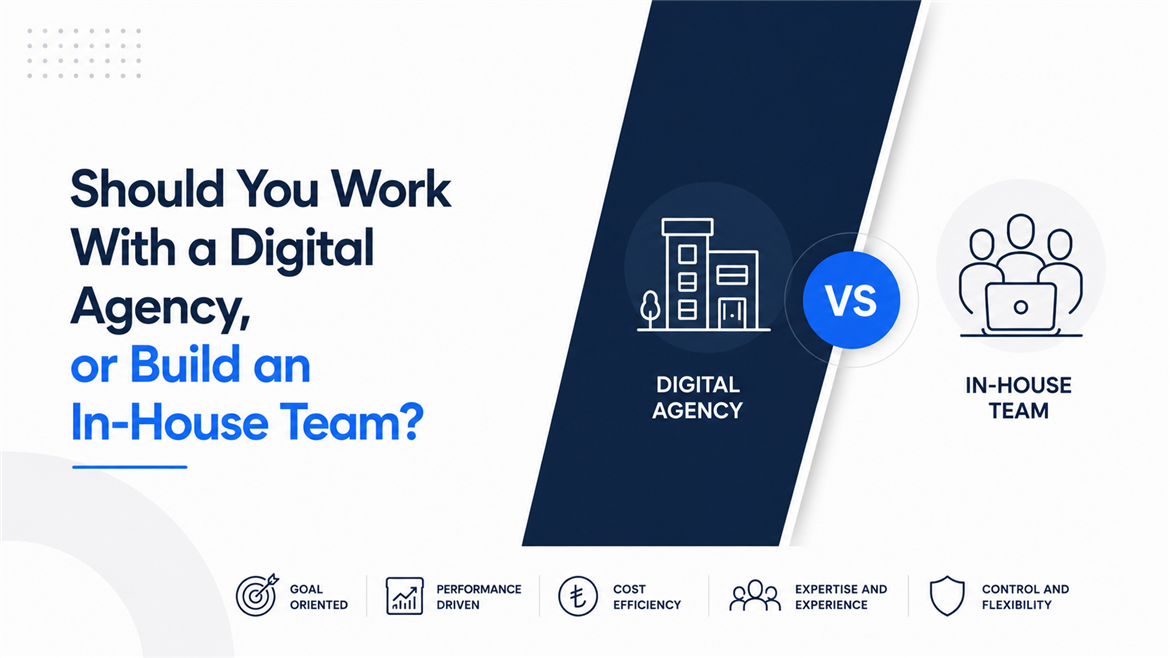
A brand has two options for managing digital marketing: outsource the work to an agency or build an in-house team consisting of a designer, advertising specialist, content writer, and SEO specialist. The right decision depends on the company's revenue, marketing budget, continuity of the workload, and management capacity. A business with a monthly marketing budget of 40,000 TL and an e-commerce brand generating millions of lira in monthly revenue from digital channels will not have the same answer.
Below, we will examine the costs, speed, risks, and conditions under which each model becomes more advantageous as clearly as possible. Our aim is not to make the decision for you, but to present the picture with numbers and real business scenarios.
What Is the Main Difference Between a Digital Agency and an In-House Team?
The most fundamental difference lies in how you access expertise. With an in-house team, you build a staff of two or three people and can only do as much as those people know. With an agency, however, the same budget can give you simultaneous access to an SEO specialist, performance marketing specialist, designer, video team, and analytics expertise. In other words, one buys depth while the other buys breadth.
The second difference is where responsibility lies. With an in-house team, both the output and inefficiency are your responsibility. When someone leaves the company, the process stops, and the advertising account may remain unattended until you find a replacement. With an agency, the service continues even when team members change because the contract is tied to the organization, not to an individual.
The third difference, and one that many people overlook, is the learning curve. An in-house team gets to know your brand very well over time, masters product details, and works closely with the sales team. An agency, on the other hand, brings patterns gained through trial and error across dozens of different industries. It has already seen which campaign structures work and which advertising formats fail in particular industries.
These three differences actually shape most of the decision on their own. If your brand sells a highly specialized and technical product, internal knowledge is critical. If you sell a standard consumer product, channel expertise becomes much more decisive.
Cost Comparison: What Do the Real Numbers Say?
This is where companies most often make mistakes. When calculating the cost of an in-house team, they usually add up only salaries, but the complete picture is much broader. The gross cost of a modest four-person team consisting of an SEO specialist, advertising specialist, graphic designer, and content writer becomes a significant monthly expense when employer contributions and fringe benefits are included.
Then there are software licenses. Rank tracking software, design programs, email marketing tools, heatmap software, stock image subscriptions, and reporting dashboards add up to a considerable annual amount. When you work with an agency, the licensing costs of these tools are usually included in the service fee, so you do not pay for them separately.
The third hidden cost is recruitment and training. Finding the right person takes an average of two months, while it can take three to six months for that person to become fully productive. During this period, you pay a salary but may struggle to obtain measurable output. If you make the wrong hire, you lose not only the salary but also valuable months. For those who want to plan their budget properly, our guide explaining how to determine a marketing budget can be a good starting point.
On the agency side, costs are more predictable. You pay a fixed monthly fee, and the scope is defined in the contract. However, there is an important point to consider here as well: agencies offering extremely low prices often assign one specialist to fifteen clients, meaning the actual time allocated to your brand may be only a few hours per week. When requesting quotations for SEO pricing, the most sensible approach is to ask how many man-hours the fee you pay actually represents.
When Does Working with an Agency Make More Sense?
The agency model clearly stands out when certain conditions come together. If three or more of the following points apply to you, outsourcing will probably be more efficient:
- If your marketing budget is not sufficient to build a full-time team. If your monthly budget barely covers the salaries of a two-person team, allocating that budget to an agency gives you access to five different specialists.
- If you need to manage multiple channels at the same time. Search engine optimization, social media, email, and advertising management require different skills. Expecting one person to handle all of them usually means all of them will be done only at an average level.
- If you need to start quickly. While recruitment can take months, an agency can usually provide its first deliverables within two weeks.
- If your workload is seasonal. If your campaign traffic increases fivefold in November and drops in February, a permanent team remains underutilized for much of the year.
- If you are entering a new channel. When working in an area you have never tried before, buying the experience of someone who has already tested it is the cheapest way to learn.
- If you need an objective perspective. In-house teams gradually develop the same blind spots as the brand, while an external perspective can identify them.
The common point behind these factors is this: during periods of high uncertainty and diversity, buying flexibility is smarter than taking on fixed costs. Once a permanent and repeatable system has been established, the equation may change.
Scenarios Where Building an In-House Team Is More Advantageous
Of course, there are also situations where the opposite is true. If the following conditions apply, building an in-house team can be both more profitable and more sustainable in the long term:
- If digital is your main source of revenue. If seventy percent of your revenue comes from your website, outsourcing this channel entirely creates a strategic risk.
- If your product is technical and difficult to explain. If you sell industrial machinery, medical devices, or specialized software, learning the product can take months. Keeping this knowledge inside the company makes more sense.
- If your operations require daily and immediate intervention. In a structure where prices change hourly and stock levels constantly fluctuate, waiting for external approval may result in lost sales.
- If your operational volume is high. Managing a catalog with thousands of products, a campaign calendar, and marketplace operations requires full-time personnel.
- If your data is sensitive. In industries where transferring customer data outside the organization is restricted, an in-house team may become a necessity.
- If you aim to build long-term brand knowledge. When an agency changes, knowledge often leaves with it; with an in-house team, institutional memory remains.
The critical point here is this: building an in-house team is not merely a cost item, but a management commitment. The person establishing the team must have the knowledge required to guide it, set goals, and measure its performance. An in-house team reporting to a manager who does not understand digital marketing can turn within six months into a structure that keeps itself busy but produces little value for anyone.
Another reality is that finding a good specialist is much more difficult than simply allocating the budget. Experienced performance marketers and technical SEO specialists are still limited in number, and these professionals usually work either at agencies or for large brands. Simply posting a job advertisement and waiting often produces no result.
Hybrid Model: Is It Possible to Use Both Together?
In practice, the most effective structure is often somewhere between the two. Brands keep strategy and brand voice in-house while outsourcing tasks that require technical expertise or intensive labor. In this model, there is an in-house marketing specialist or manager, while an external agency handles execution.
The division of responsibilities usually looks like this: the in-house person manages product knowledge, the campaign calendar, communication with the sales team, and approval processes. The agency takes responsibility for optimizing advertising accounts, SEO activities, content production, and reporting. This way, brand knowledge is preserved while specialist expertise remains available.
The biggest advantage of this structure is scalability. As the business grows, you can reduce the scope of services purchased from the agency while expanding the internal team. During periods of contraction, you can do the opposite without having to dismiss employees. Keeping fixed costs low while adjusting capacity according to need provides significant flexibility, especially for companies in the growth stage.
The only major risk in the hybrid model is blurred responsibility. If it is not clearly documented who is responsible for delivering what, both sides may assume that the other party is handling a task, leaving it unfinished. The way to prevent this is to keep monthly objectives and deliverables in a single document. You can see how this division of responsibilities is structured in practice on our page explaining how we work.
Questions You Should Ask Yourself Before Making a Decision
The most practical approach at the decision stage is to answer a few clear questions about your own situation rather than relying on abstract comparisons. The answers to these questions often make the picture clear on their own.
The first question is about budget: how much of your annual marketing budget goes toward personnel costs, and how much goes toward actual advertising investment? If personnel costs exceed half of the total budget, your advertising investment is probably not large enough to justify that staffing structure. In this case, the agency model allows you to direct a larger proportion of the budget toward actual investment.
The second question is about time: who will manage this team and how many hours per week will that person allocate? An in-house team loses efficiency when left without proper management. If you cannot dedicate at least six or seven hours per week to management, outsourcing the management burden may also be the better choice.
The third question is about measurement: which metric will you use to measure success? Traffic, conversions, or generated revenue? Both models will turn into an argument after six months if they begin without clearly defined success criteria. Clarifying from the outset how ROI in digital marketing should be calculated eliminates one of the biggest sources of disagreement between the parties in the following months.
The fourth question is about continuity: what happens if the person managing the work today leaves tomorrow? If your answer is "everything stops," you have built a structure dependent on one person. This risk exists both in in-house teams and in agency relationships that depend on a single specialist.
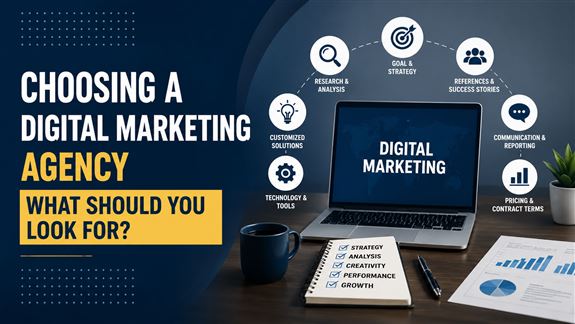
What Should You Consider If You Decide to Work with an Agency?
When the right agency is selected, the model works. When the wrong agency is selected, companies often conclude that "agencies do not deliver results." In reality, the problem is usually not the model but the selection criteria.
First, make sure the scope is written clearly. The contract should specify how many pieces of content, how many advertising campaigns, and how many hours of technical work will be delivered each month. Broad terms such as "social media management" mean little on their own; the details underneath must be defined. The frequency and content of reporting should also be determined in advance.
Second, get to know the team assigned to you. The person attending the sales meeting and the person actually doing the work are often different. Asking who will manage the project and how many brands that person is responsible for gives you a realistic idea of how much attention your account will receive.
The third point is account ownership. Advertising accounts, analytics dashboards, and domain management should be opened in your name. When you change agencies, keeping your historical data is critical for maintaining measurement continuity over the long term. We discussed this topic in greater detail in our article on what to consider when choosing a digital marketing agency.
Finally, expectation management matters. Expecting revenue growth from the first month pushes both the agency and the brand toward the wrong actions. On the search engine side, meaningful movement is generally seen within three to six months. On the advertising side, the first meaningful data usually appears within four weeks, but optimization is continuous.
In Summary: Which Model Is Right for You?
For companies with limited budgets that need to be visible across multiple channels and want to start quickly, the agency model has a clear advantage. With the same budget, you gain access to a broader pool of expertise, avoid fixed staffing costs, and eliminate recruitment risk.
For brands that have made digital their primary revenue channel, have high daily operational volume, and sell technical products, an in-house team creates a stronger long-term structure. The key condition is having sufficient experience within the company to manage that team.
For most companies, the most realistic answer lies somewhere in between: one person in-house who makes decisions and understands the brand, supported by an external team that handles execution. In short, when the question shifts from "agency or in-house team?" to "who should do which task?", the picture becomes much clearer.
If you would like to determine which structure best suits your organization, as a digital marketing agency we can evaluate your current situation and define the scope you need together. You can also reach us through our contact page.
Frequently Asked Questions
Which is cheaper, a digital agency or building an in-house team?
For most small and medium-sized businesses, the agency model is more economical. With an in-house team, employer contributions, software licenses, training, and recruitment costs are added on top of salaries. With an agency, most of these items are included in the service fee, making monthly costs more predictable.
What is the minimum number of people required to build an in-house team?
A basic structure requires at least three people: a specialist handling advertising and performance, someone responsible for content and SEO, and a designer responsible for visual production. Structures built around a single person quickly become bottlenecks because these areas require different skill sets.
Do you lose control of the brand when working with an agency?
As long as advertising accounts, analytics dashboards, and domain management are opened in your name, control remains with you. Clearly defining the scope, approval workflow, and reporting frequency in the contract is also important for maintaining control.
Does it make sense to work with an agency while also having an in-house team?
This is one of the most commonly preferred structures in practice. Brand knowledge, product details, and approval processes remain in-house, while technical expertise and labor-intensive tasks are outsourced to the agency. Clearly documenting the division of responsibilities is critical to prevent tasks from being left unattended.
How long does it take to get results from an agency?
On the advertising side, the first meaningful data usually appears within four weeks. In search engine optimization, sustainable movement is typically seen within three to six months. Industry competition, the current condition of the website, and the allocated budget directly affect these timeframes.
Do my previous efforts reset when I change agencies?
Not as long as you retain account ownership. Advertising history, content, and technical improvements remain on your website. Problems usually occur when accounts are opened in the agency's name, which is why account ownership should be clarified from the first day.

Do Comment