
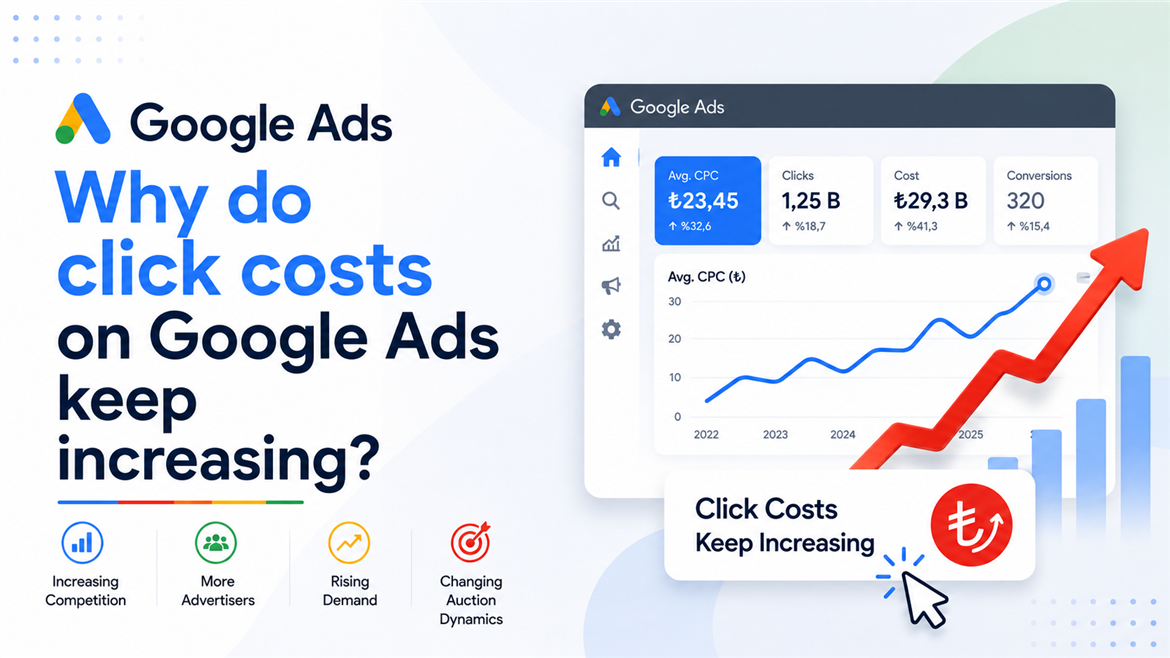
The main reason why click costs in Google Ads are increasing is that the number of advertisers competing for the same keywords grows every year and the pricing model is based on an auction system. Google Ads does not operate with a fixed price list; a real-time auction takes place for every search query, and the cost per click (CPC) is determined according to the level of competition at that moment. As demand increases, prices naturally rise.
However, competition is not the only factor behind the increase. Many elements such as a low Quality Score, an incorrect account structure, the wrong bidding strategy, and economic conditions come together to push costs upward. Sometimes advertisers unknowingly make decisions that increase their own costs, causing the budget to disappear quickly. In this article, we will examine the reasons that increase click costs one by one and explain clearly what can be done to bring these costs under control.
How Does the Google Ads Auction System Work?
The moment a user performs a search on Google, an auction takes place within milliseconds among all advertisers who want to display an ad for that query. In this auction, not only your bid but also the quality of your ad and the expected click-through rate are taken into account. In other words, the highest bidder does not always appear at the top; Google evaluates bid and quality together to determine Ad Rank.
The amount you pay is usually lower than your maximum bid. The system charges you the minimum amount required to outrank the competitor directly below you. Although this sounds fair, there is a critical detail: as your competitors increase their bids, the amount you need to pay to maintain the same position automatically increases as well. Even if no one raises their bid, the balance changes as new advertisers enter the auction.
This is why click costs are not static. Paying 5 TL for the same keyword last year and 15 TL today does not necessarily mean you have made a mistake. Market dynamics have changed, and the auction environment still operates under the same rules but with a much larger number of participants.
The Impact of Increasing Competition and Digitalization on Costs
Digital advertising investments continue to grow every year in Türkiye and around the world. Google Ads, once used mainly by large brands, has now become a channel used by everyone from local businesses to e-commerce giants. Advertising space is limited, while demand continues to increase. The most basic rule of economics applies here as well: when supply remains fixed and demand rises, prices increase.
Especially after the pandemic, the shift of physical stores toward online channels significantly intensified competition. Even sectors that previously did not allocate budgets to digital marketing now participate in auctions with aggressive bids. In industries such as insurance, finance, legal services, healthcare, and e-commerce, the cost of a single click can reach three-digit figures for certain keywords.
Another important factor is that large brands also enter high-volume generic keywords through brand awareness campaigns. This narrows the room for small and medium-sized businesses. Campaigns run without the right strategy can effectively turn into budget-burning machines in such a competitive environment. This is why positioning more intelligently in auctions through professional Google Ads management is more valuable than ever.
Quality Score: The Factor That Quietly Increases Costs
Google assigns each of your keywords a Quality Score between 1 and 10. This score consists of three components: expected click-through rate, ad relevance, and landing page experience. An advertiser with a low Quality Score must pay significantly more than a high-scoring competitor for the same position. In other words, the reason for increasing costs is sometimes not competition but your own account.
One of the most common reasons for a low Quality Score is the disconnect between the ad copy and the landing page. If a user searches for "men's leather shoes" and clicks an ad that directs them to the homepage, both the likelihood of conversion decreases and Google evaluates the experience negatively. You can find more detailed information about the impact of page content on ad performance in this article.
Landing page speed is another frequently overlooked factor. A page that loads slowly on mobile devices causes users to leave and gradually reduces the Quality Score. An account with a Quality Score of 3-4 may pay two or three times more for the same click compared to a competitor with a score of 8-9. When this difference is reflected in the monthly budget, it can result in a significant loss.
The Role of Automated Bidding Strategies and Smart Campaigns
In recent years, Google has been steering advertisers toward automated bidding strategies and smart campaign types such as Performance Max. When these systems are fed with the right data, they can produce strong results; however, when configured incorrectly, they can increase costs uncontrollably. This is because machine learning will not hesitate to pay very high amounts per click if necessary to achieve its goal.
For example, an account using the "maximize conversions" strategy without setting a target cost is essentially telling Google, "spend my budget however you want." The system does not avoid expensive auctions in order to consume the daily budget, and the average CPC can rise quickly. If conversion tracking is incomplete or incorrectly configured, the algorithm learns from the wrong signals and money is spent inefficiently.
We are not saying automation is bad; on the contrary, when supported by the right goals and reliable data, there are many scenarios where it delivers better results than manual management. The key is not leaving automation unchecked. Defining limits such as target CPA and target ROAS and regularly reviewing campaign data are among the most effective ways to control rising costs. To understand whether your advertising spend is actually generating profit, be sure to review how to calculate ROI in digital marketing.
Common Account Mistakes That Increase Click Costs
In many cases, increasing costs are not caused by external factors but by structural mistakes within the account. The mistakes we have repeatedly encountered over years of managing accounts and that quietly drain budgets include:
- Uncontrolled use of broad match keywords: Showing ads for irrelevant searches consumes the budget and reduces the click-through rate, damaging the Quality Score.
- No negative keyword list: Every click from searches such as "free", "second hand", or "how to" that do not indicate purchase intent is wasted money.
- Combining all products and services into a single campaign: Budget allocation becomes difficult to control, and underperforming areas consume the budget of high-performing ones.
- Not using ad extensions: Sitelinks, callouts, and call extensions increase the space occupied by the ad, improve click-through rates, and indirectly reduce CPC.
- Ignoring location and time targeting: Advertising in cities you do not serve or during hours that do not generate conversions creates unnecessary costs.
- Not setting up conversion tracking: Any optimization performed without knowing which keyword generates sales is nothing more than guesswork.
Each of these mistakes may appear small on its own; however, when combined, they can cause a significant portion of the monthly advertising budget to be spent inefficiently. Conducting regular account audits is the most effective way to detect these leaks early.
Cost Differences by Industry and Keyword
Click costs are not the same across all industries because the value each click brings to the advertiser differs. While a single client may generate thousands of lira in revenue for a law firm, the value of a single sale for a stationery store is much lower. Naturally, lawyers are willing to bid more per click, which increases the average CPC in the legal sector.
The search intent behind a keyword also directly affects its price. A purchase-oriented query such as "air conditioner prices" is several times more expensive than an informational query such as "how does an air conditioner work." As commercial intent increases, competition intensifies and costs rise. Therefore, when planning a campaign, you should consider not only search volume but also the intent behind the keyword and the actual value it can bring to your business.
Seasonality is another important dynamic that should not be ignored. During periods such as holidays, back-to-school season, and Black Friday, bids increase in almost every industry. Accepting higher costs as normal during these periods and planning the budget accordingly results in a more predictable advertising spending profile at the end of the year.
The Impact of Economic Conditions and Exchange Rates
There is another reality that advertisers in Türkiye cannot ignore: Google Ads billing is part of an ecosystem that operates on a US dollar basis. Every movement in the exchange rate is directly reflected in the amounts you pay in Turkish lira. Compared with previous years, a click with the same dollar cost has become significantly more expensive in TL terms.
In addition, digital services tax and similar legal deductions are among the items that increase total advertising costs. Most advertisers focus only on the CPC figure displayed in the panel; however, when taxes and exchange rate differences are included, the actual cost is higher than expected. Taking these items into account from the beginning when planning the budget helps prevent unpleasant surprises at the end of the period.
While customer acquisition costs generally increase in an inflationary environment, businesses also become more dependent on advertising channels. The right approach in this situation is not to stop advertising, but to move toward a conversion-focused structure where every unit of spending is accountable. Alongside paid traffic, strengthening organic visibility through SEO efforts is one of the smartest ways to reduce pressure on advertising budgets in the long term.
Methods That Can Be Used to Reduce Click Costs
Now that we have examined all the reasons behind rising costs, let's look at concrete steps that can turn the situation in your favor. When implemented correctly, the following methods can significantly reduce average CPC:
- Improve your Quality Score: Write ad copy that is relevant to the keyword and direct each ad group to a landing page specifically related to its topic.
- Focus on long-tail keywords: Specific keywords such as "genuine leather men's classic shoes" instead of "shoes" are generally cheaper and have higher conversion rates.
- Update your negative keyword list weekly: Regularly review the search terms report and eliminate irrelevant queries.
- Use ad scheduling: Reduce bids or pause ads during hours and days that do not generate conversions.
- Improve the landing page experience: Increase page speed, ensure perfect mobile compatibility, and provide a clear call to action. At this point, conversion rate optimization efforts can make a significant difference.
- Set up remarketing campaigns: Reaching users who have already visited your website is much more economical than advertising to cold audiences.
- Set limits on bidding strategies: Keep the algorithm's spending behavior under control by defining a target CPA or target ROAS.
None of these steps is a one-time task. Google Ads is a dynamic system, and the competitive environment is constantly changing. Establishing a regular weekly optimization routine is the only way to keep costs at reasonable levels over the long term.
In short, although increases in click costs are largely driven by market realities, the extent to which those increases affect your account is entirely within your control. With a properly structured account, high-quality landing pages, and a disciplined optimization process, it is possible to reach the same audience at significantly lower costs than your competitors. If you are not sure whether your budget is being managed efficiently, starting with a professional audit can save you both time and money.



Do Comment