
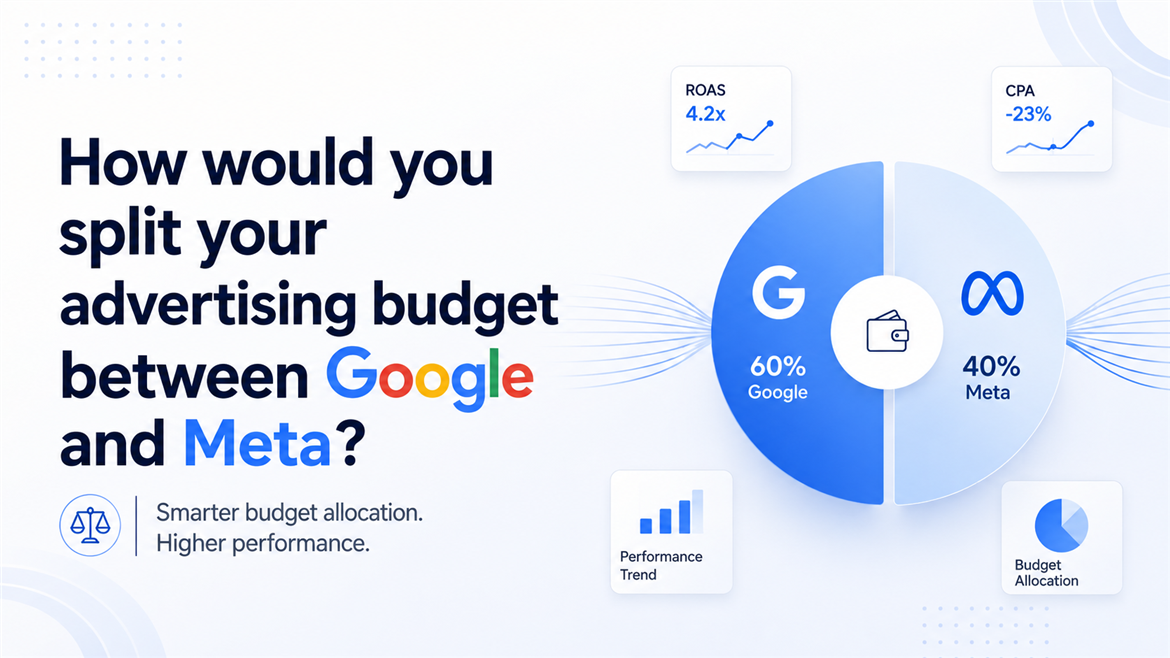
There is no single correct ratio for dividing an advertising budget between Google and Meta, but there is a working logic: Google captures existing demand, while Meta creates demand. Therefore, if there is already an audience searching for your product, the budget should lean toward Google; if you need to reach an audience that does not yet know your product, the weight should shift toward Meta. In practice, for most businesses, a starting point is around 60/40 or 70/30, and this ratio is reshaped based on the data from the first 60 days.
Below, I explain step by step which data you should consider when making this allocation, how it changes by industry, and at what point you should intervene.
The First Question in Budget Allocation: Does Demand Exist or Does It Need to Be Created?
If a product has monthly search volume and people search for it by name, there is no reason not to allocate a large portion of the budget to the search network. Someone typing "air conditioner installation prices" is already near the end of the purchasing process. To advertise to this person on Meta, you first need to find them, then attract their attention, and finally convince them. On Google, you simply need to appear.
On the other hand, the situation is reversed for products that define a new need and have no established market demand. People cannot find something on Google that they are not searching for. In such cases, Facebook ads and visual storytelling on Instagram provide a much more suitable environment for showing what the product does.
You can use a simple test to clarify this distinction. Check the main keywords in your category using search volume tools. If the total monthly volume is low and your competitors are barely visible in the search results, demand has not yet developed. In this situation, allocating most of the budget to search means trying to buy traffic that does not exist.
There is also a third possibility: demand exists, but click costs have reached unsustainable levels due to competition. In areas such as legal services, insurance, and private healthcare, the cost of a single click can exceed hundreds of lira. Instead of abandoning Google completely, it makes much more sense to limit it to narrower, high-intent keywords and generate additional volume through Meta.
What Is the Fundamental Difference Between Google and Meta?
Both platforms may seem to do the same job, but their points of contact with users are completely different. On Google, the user comes to you; on Meta, you go to the user. This difference directly determines how the budget behaves.
Conversions are faster on the search network because intent already exists. The average conversion path is short, and the time between the first click and purchase can sometimes be measured in minutes. On Meta, however, users encounter your ad while scrolling through their feed. Expecting a purchase at the first interaction is unrealistic; the journey usually involves between two and five touchpoints.
The cost structure is also different. On Meta, the cost per thousand impressions is low, allowing you to reach large audiences cheaply, but how much of that audience actually consists of potential customers is debatable. On the Google Ads side, clicks are expensive, but the traffic quality is high. In other words, one sells volume while the other sells quality.
The two platforms also report the same event differently when it comes to measurement. Because Meta attributes view-through conversions to itself, the numbers in its interface often appear inflated. Google, on the other hand, is click-based. Do not be surprised if the combined totals from both platforms exceed your actual number of sales; this happens in almost every account and is one of the most common reasons behind poor budget decisions.
Budget Allocation Ratios by Industry
The same budget allocation does not work in every industry. The ratios below are the starting points I most frequently encounter in practice; they are not strict rules but guidelines:
- E-commerce (fashion, accessories, home decoration): Meta 60%, Google 40%. Since visuals directly influence purchasing decisions, a discovery-focused approach generally produces more efficient results.
- B2B and corporate services: Google 70%, Meta 30%. The decision-making process is longer, and people actively research solutions.
- Local services (plumber, dental clinic, auto service): Google 75%, Meta 25%. Urgent needs begin with search, and map results are decisive.
- Education and courses: Balanced allocation, 50%/50%. Both search volume and the persuasion process are strong.
- New products and brands: Meta 70%, Google 30%. You first need to become known before people begin searching for you.
- High-ticket products (furniture, home appliances): Google 55%, Meta 45%. Research behavior is intensive, so both channels work together.
Instead of copying and applying these ratios directly, you need to test them with your own data. Industry averages provide a useful benchmark for getting started, but if you are still using exactly the same ratio after three months, you are not optimizing.
How Should the 70/30 Approach Be Applied at the Beginning?
For an account starting from scratch, dividing the budget equally between two platforms may seem attractive, but it does not work. You cannot collect enough data on either platform to complete the learning phase, and both remain underdeveloped. Instead, it is healthier to give one platform the majority of the budget and keep the other in a supporting role.
Let's say you have a monthly advertising budget of 30,000 TL. Allocate 21,000 TL to the primary channel and 9,000 TL to the secondary channel. Use the demand test described above when selecting the primary channel. This gives you at least a chance of reaching the weekly conversion threshold the algorithm needs on one platform.
The reason for not shutting down the secondary channel completely is data collection. Even if a campaign running on a low budget does not generate conversions, it teaches you which audiences respond and which creatives attract attention. This information becomes your only reference when you need to shift the budget in the second month.
At the end of the thirtieth day, compare the customer acquisition costs of both channels. If the difference is less than twenty percent, it is generally worth maintaining the current allocation. If the gap has clearly widened, shift the budget gradually rather than all at once. Sudden budget changes temporarily disrupt performance on both platforms.
Data You Should Check Before Dividing the Budget
Making an allocation decision based on intuition means wasting part of the budget from the start. Before making a decision, evaluate the following factors:
- Average order value and profit margin: The amount you retain per product determines the maximum customer acquisition cost you can afford.
- Website conversion rate: If your website cannot convert traffic into sales, it does not matter how much you allocate to each platform. At this point, conversion rate optimization should come before advertising.
- Existing organic traffic structure: If you are already strong in search results, you can shift the budget toward discovery instead of advertising for the same keywords.
- Customer decision-making period: A product purchased on the same day and a service considered for two weeks require different channel weightings.
- Your visual and video assets: If you do not have usable content, your Meta budget will be wasted. In that case, you first need to solve the content production side.
- Repeat purchase behavior: If customers return, you can more easily absorb the cost of the first sale, which allows you to invest more aggressively in acquisition channels.
Once these six points are clarified, the allocation decision becomes much easier. A data-supported starting point also provides the foundation for adjustments you will make in the following months.
How Long Should the Test Period Last?
Two weeks is not a sufficient testing period for either platform. Meta's learning phase is based on approximately fifty conversions per campaign per week, and with small budgets, reaching this threshold can take a month. Smart bidding strategies on Google also require a similar maturation period.
A healthy testing window is at least 30 days, preferably 45 days. During this period, keep the campaign structure, targeting, and budget as stable as possible. In accounts where settings are changed every three days, the algorithm continuously starts over, data cannot accumulate, and you never build a reliable basis for making decisions.
The metric you should focus on during the testing period is not the number of conversions but the cost per conversion. A channel that generates ten sales at 900 TL per sale is performing worse than one that generates three sales at 300 TL per sale. Focus on the ratio, not the number.
At the end of the period, compare the data from both channels in the same table. When calculating return on advertising spend, rely on your own sales records rather than platform dashboards. We explained in detail how to structure this calculation in our article on calculating ROI in digital marketing.
When Should You Change the Allocation?
Budget allocation is not something you set once and forget. Seasonal movements, new competitors, and campaign periods continuously put pressure on the ratio. During New Year campaigns, end-of-season sales, or special occasions, Meta costs may increase while purchase intent intensifies on Google.
The clearest signal for making a change is when one channel's customer acquisition cost remains above your target for two consecutive weeks. One-week fluctuations are normal, but if the issue repeats in the second week, there is likely a structural problem. Before cutting the budget, check the creative and landing page sides.
Apply a rule in the opposite direction as well. If one channel is generating costs significantly below your target, increase its budget in twenty-percent increments. Doubling the budget in a single move usually damages performance because the algorithm expands the audience in order to spend the new budget.
Also develop the habit of conducting an annual review. Rebuilding the entire allocation from scratch once a year allows you to question decisions that may have continued simply out of habit. Our marketing budget planning guide can help you determine how to plan your overall budget.
Common Budget Allocation Mistakes
The most common mistake is treating the two platforms as competitors. The same customer may discover your brand on Instagram and search for your name on Google two days later. If you look only at the last click and cut the Meta budget, you may actually be eliminating the source that feeds Google.
The second mistake is adding together the conversion numbers from both platforms. The platforms may each claim the same sale. Therefore, measurement must be managed from a single source. In accounts without an advanced analytics setup, budget decisions are almost always based on incorrect data.
The third mistake is dividing the budget into too many small pieces. In an account running five campaigns, fifteen ad groups, and scattered small budgets, none of the campaigns can learn effectively. Concentrating spend across a small number of campaigns produces much better results than a fragmented structure.
Finally, another mistake is treating the advertising budget independently from the website. On a website with slow page speed and a poor mobile experience, both channels will lose money. Before increasing traffic, you need to strengthen the infrastructure that will receive that traffic. If you would like to create an allocation plan tailored to your organization, you can contact us.
In short, the allocation between Google and Meta is not a fixed formula but a constantly evolving balance. Businesses that correctly understand whether demand already exists, remain patient throughout the testing period, and make decisions based on centralized data can generate significantly more business with the same budget.
Frequently Asked Questions
What percentage of my advertising budget should I allocate between Google and Meta?
There is no single standard ratio. If your product has high search volume, you can start with Google 70% / Meta 30%; if your product is new and relies heavily on visual storytelling, you can start with Meta 70% / Google 30%. This ratio should then be adjusted gradually based on the data from the first 30-45 days.
Is it a good idea to advertise on both platforms with a small budget?
With very small budgets, splitting the budget prevents both channels from completing their learning phase. In this case, it is more efficient to allocate most of the budget to one primary channel and keep the other active with a small amount solely for data collection.
Why don't the conversion numbers on the two platforms match?
Meta attributes view-through conversions to itself, while Google primarily uses click-based measurement. The same sale may therefore appear in both platforms. For this reason, you should base your decisions on your own sales records rather than platform reports.
How often should I change the budget allocation?
You should not react to weekly fluctuations. If a channel's customer acquisition cost remains above target for two consecutive weeks, it may be time to make a change. Shifting budgets in 20% increments rather than all at once helps preserve performance.
Which provides cheaper conversions, Google or Meta?
Meta has a lower cost per thousand impressions, but the conversion journey is longer. Clicks are more expensive on Google, but conversion rates tend to be higher because user intent is stronger. Which platform is cheaper depends on the industry, average order value, and level of competition.
How long should the test period be?
At least 30 days, preferably 45 days, are required to make a reliable decision. Keeping the campaign structure and budget stable during this period is important for allowing the algorithm to accumulate data.



Do Comment