
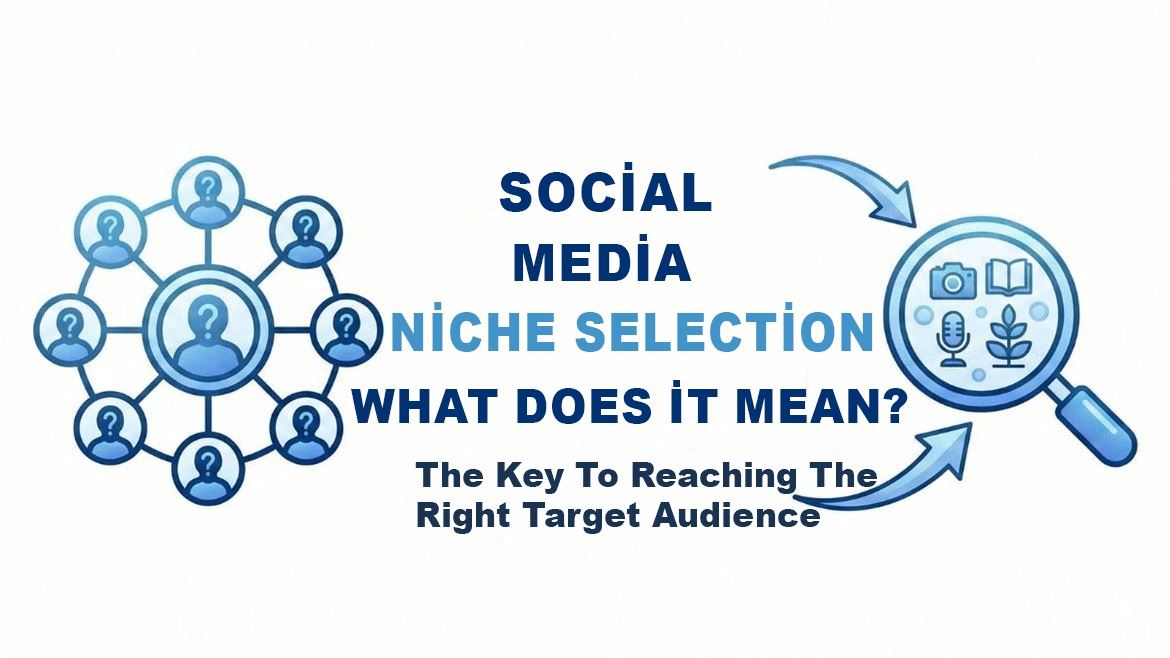
Choosing a niche on social media means cutting through the massive digital noise and focusing on a specific area of expertise, a particular topic, or a clearly defined target audience. Instead of making generic posts, it means going deeper in a category with clear boundaries and becoming a reference point in that field. In short, niche selection is the strategy of “reaching the right people and building a loyal community” rather than “trying to appeal to everyone and reaching no one.”
This strategy is the fastest way to teach algorithms what your account is about. When you share a recipe one day and tech news the next, social platforms struggle to categorize you and cannot determine who to show your content to. But when you define a clear niche, the platform presents you more often to users who are interested in that topic. This organically increases your engagement rates and gives profile visitors a logical reason to hit the “follow” button.
A successful niche choice is not just about following what’s popular; it’s about combining your strengths with a gap the market needs. Instead of getting lost in highly competitive main categories, you can stand out by going into sub-branches of that category. For example, instead of saying “healthy living,” focusing on “10-minute workouts for office workers” turns you into an indispensable authority in that area. This focus supports sustainable content creation and makes it easier for brands and collaborations to notice you.
Why Should You Appeal to a Specific Audience Instead of Everyone?
In a digital world where everyone seems to know everything, trying to be “everything for everyone” usually results in not fully capturing anyone’s attention. Social media algorithms expect clarity when deciding whose feed your content should appear in. When you narrow your focus and speak to a specific audience, you gain the chance to directly address their specific problems, curiosities, or dreams. This creates a real bond built on mutual trust rather than surface-level interaction. As the audience becomes smaller, community loyalty and interest in your content grow exponentially.
The advantages of focusing on a specific audience can be summarized as follows:
- By specializing in your topic, you become a sought-after and trusted name in that field in a short time.
- Instead of irrelevant crowds, you build a quality community that genuinely expects your posts and engages with them.
- You increase your organic growth speed by helping algorithms clearly understand who to recommend your content to.
- If you sell a product or service, your conversion rates become much higher than general accounts because you speak to the right audience.
- You avoid confusion about what to post and create a planned, sustainable roadmap for content production.
This strategic narrowing does not limit your account’s growth potential; on the contrary, it opens the door to growth built on solid foundations. People tend to follow accounts that make them feel seen and answer their interests precisely. When you put down roots in a specific area, you become a natural part of that community and achieve brand value that spreads by word of mouth without needing ad spend. Remember: in the digital crowd, standing out is not about shouting louder, but about whispering the right thing into the right ears.
Critical Questions You Should Ask Yourself While Finding Your Niche
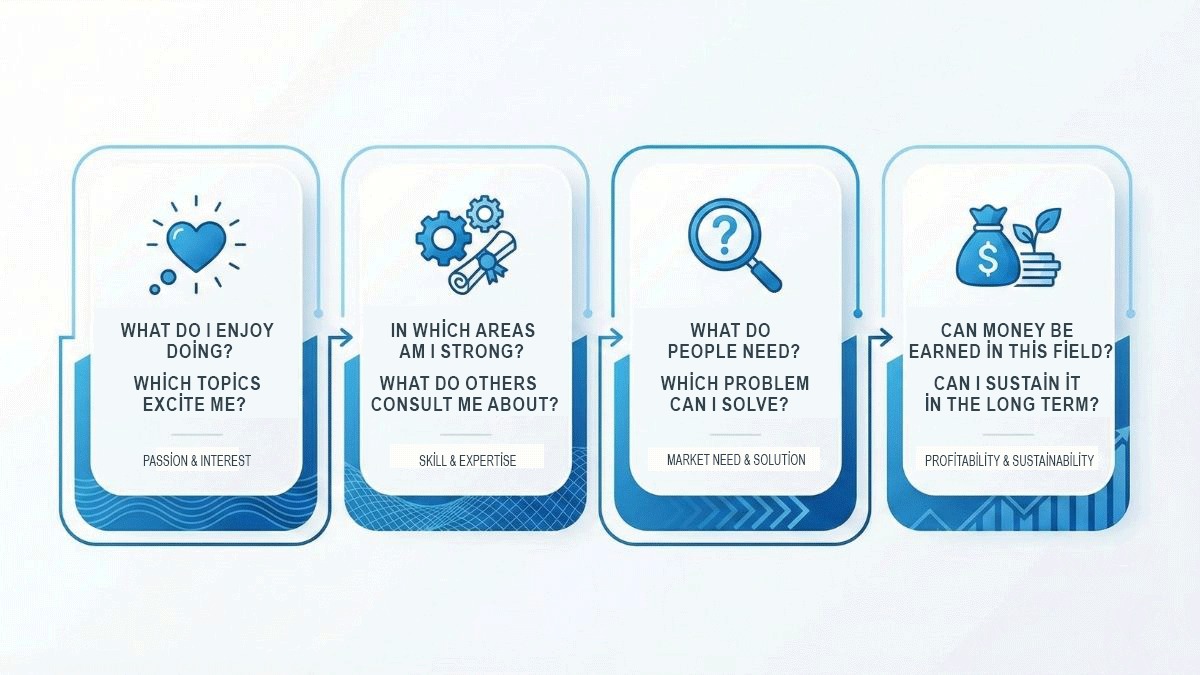
Finding the right field is not just about following trends; it’s about discovering the fine line between your competencies and the market’s expectations. Many people lean into topics only because they are popular, but for sustainable success you must combine internal motivation with external demand. An honest self-assessment prevents you from getting bored with content creation months later and clarifies why your audience should trust you. Instead of moving randomly, filtering your direction strategically puts you several steps ahead of your competitors.
The main criteria that will clarify your roadmap and help you determine the best field for you can be listed as follows:
- What can I talk about, research, and teach others for hours without getting bored?
- Which of my existing skills, professional background, or hobbies genuinely adds value to other people’s lives?
- In this field, what chronic problems are people waiting to be solved, or what missing points are they searching answers for?
- Do I have enough depth to produce content regularly in this topic, or is it just a temporary enthusiasm?
- Does the audience I’m targeting have time for content in this field, and can this topic turn into a long-term business model?
After making these evaluations, the topics that remain represent your natural authority zone. When you match your potential with gaps in the market, content creation turns from an obligation into an enjoyable process. At the point where sincerity and expertise meet, your followers will feel that you are not only a channel that provides information, but also a guide to consult in that area. Choosing the right field means you have successfully completed half of your digital journey.
How to Stand Out in Oversaturated Categories on Social Media
The key to gaining ground in popular categories is to cover topics everyone talks about through a perspective no one else uses. In fields like fashion, technology, or personal development—where millions of pieces of content are produced—rather than offering general information, you should integrate your personal experiences and unique storytelling style into the process. People trust authentic profiles with real stories and imperfections more than perfectly polished, artificial content. Blending your expertise with your character will immediately separate you from thousands of similar accounts.
In highly competitive fields, turning toward vertical specializations is a strategic move. Instead of speaking only about healthy eating, you can focus on a much more specific subtopic such as practical and healthy snacks for busy office workers. With this method, rather than competing with market giants, you start dominating smaller but highly engaged communities that those giants cannot reach or neglect. The narrower your focus, the faster your authority rises within that circle.
Breaking away from the usual in visual language and presentation techniques makes users stop on a fast-scrolling screen. Instead of standard templates or stock visuals everyone uses, choose color palettes and original video edits that reflect your brand’s spirit. By prioritizing creativity in how you present information, you can turn even boring data into a fun infographic or a short story. Aesthetic consistency and a unique visual signature enable your audience to recognize your content even before they see your logo.
In community communication, acting not only as a broadcaster but also as an active moderator increases loyalty. Responding sincerely to comments, producing content based on followers’ questions, or including their ideas in the content creation process creates a sense of belonging in crowded categories. These one-to-one touches—often neglected by big accounts—make followers feel valued and turn you into an indispensable reference point. A dynamic engagement network also extends the lifespan of your content within algorithms.
Finally, you must move with data and analyze what details your audience responds to most. By identifying missing points in your competitors’ highest-performing posts and creating content that fills those gaps, you can gain market share. Staying fresh by adapting new trends to your own style—rather than remaining static—helps you stay relevant even in saturated markets. Remember: there is no “no room” in the digital world; there are only doors that haven’t been opened with the right strategy.
What Common Characteristics Do Profitable Niches Share?
In the digital world, niches with high income potential typically revolve around topics where people urgently seek a solution, feel strong passion, or want to directly improve their quality of life. Producing interesting content alone is not enough to build a sustainable income stream. At the core of truly profitable niches is an audience that is willing to allocate a budget to solve a problem or achieve a desire. In these fields, every piece of content creates tangible value in the viewer’s life while serving as a bridge that offers high conversion potential for brands.
The main characteristics found in economically valuable and commercially successful niches are as follows:
- The target audience has high purchasing power or a strong willingness to spend money related to the topic.
- The shared information directly solves a problem, saves time, or carries the potential to generate financial return.
- Advertisers and brands are in intense competition to reach audiences in this field.
- The content consists of information that retains its value long-term and is continuously searched for, not just momentary trends.
- The targeted group already feels strong trust and need for a specific product or service.
When making a commercially focused choice, you must go beyond popularity and read supply-demand dynamics well. A topic being widely discussed does not necessarily mean it will generate high revenue; what matters is how easily that traffic can convert into action or sales. When you choose a field with real commercial value and analyze it correctly, you can manage your own products or collaborations far more effectively without being dependent on ad revenue. A strategic approach and market analysis are the strongest tools that turn your creativity into economic freedom.
The Most Common Mistakes When Choosing a Niche That Prevent Account Growth
Many content creators make the first and biggest mistake by turning to topics completely unfamiliar to them just because they are popular. Choices that do not involve sustainable passion soon turn content creation into a burden and lead to a decline in quality. The audience quickly notices this structure—detached from sincerity and focused only on engagement—and loses trust in the account. Trying to look like an expert in a field you do not care about is the biggest psychological and technical barrier to growth.
Keeping the focus too broad is another common mistake that prevents an account from forming a clear identity. Sharing financial advice and pet care content on the same profile confuses the algorithm and makes it impossible for content to reach the right audience. Followers are unlikely to regularly visit a page when they don’t know what to expect. Failing to draw clear boundaries also reduces brands’ appetite to collaborate with you and creates an unprofessional image.
Choosing an extremely narrow or low-demand field purely on instinct without market research can completely stop growth. Your topic may be so specific that the total number of people interested worldwide may not be enough to build a community. An unanalyzed niche can make you hit your ceiling quickly and stagnate. Failing to establish the balance between ignoring trends entirely and chasing only trends creates a strategic gap that wastes your efforts.
Finally, expecting better results by copying competitors destroys your originality. Replicating a successful account’s strategy word for word keeps you in their shadow as a soulless imitator. You must ask yourself: if people can follow the original, why would they choose a copy? Every moment you fail to add your own voice and perspective lays the groundwork for your growth momentum to slow down permanently.
Your Interest or the Market’s Need? | Which Is More Important?
When starting your social media journey, balancing personal passions with real market demand is one of the most fundamental factors that determines the durability of your success. Focusing only on what you like can give you strong motivation to produce, but if those topics have no market counterpart, your posts may not go beyond a small circle. On the other hand, producing content in a field you dislike solely based on market needs can cause you to lose the spirit of the work and experience burnout over time. The ideal approach is to discover that golden point where your knowledge and excitement intersect with topics people are already searching for solutions to or are genuinely curious about.
For a long-term growth strategy, market need usually serves as the compass, while your interest is the fuel for the journey. Analyzing what people search for and where gaps exist helps you reach a target audience much faster in the early stages. However, unless you blend this data with your unique perspective and sincerity, your content will be no different from generic AI output. Ultimately, building on market demand while presenting it through the filter of your interests is the most rational approach to being noticed by both algorithms and real users.
What Should the First 30-Day Content Plan Look Like After You Choose Your Niche?
The first month after choosing the right field is the most critical period—when you lay your foundation and prove what you promise to your followers. Instead of posting randomly, you must progress systematically to earn your audience’s trust and help the algorithm label you correctly. In the first weeks, introduce yourself and your expertise; in the following days, reinforce your authority by focusing on content that offers practical solutions to your audience’s most basic problems. Consistency is not only about posting every day, but also about keeping your message at the same quality and focus in every piece of content.
You can plan the strategic content distribution you should follow in the first 30 days as follows:
- Dedicate the first week entirely to introduction and vision posts, clearly explaining why you are in this field and what value you will add.
- In the second week, identify the most frequently asked questions or the three biggest problems your audience faces and prepare educational guides to address them.
- In the third week, cover common misconceptions in your field and present a distinctive, pattern-breaking perspective.
- In the fourth week, focus on sincere content that increases engagement by answering questions from your audience and involving them in the process.
- Throughout the process, consistently use the keywords and relevant hashtags that define you under each video or visual to feed the algorithm.
By the end of this first month, you will have concrete data about which topics attract more interest. The first 30-day plan is not an end; it is a major testing phase to read audience behavior. By analyzing which content types get saved or shared more, you should shape the second month’s strategy accordingly. Rather than trying to be perfect at the start, focusing on being consistent and present will open the doors to organic growth much faster. Moving patiently and strategically is the safest way to build a loyal community in a short time.
Changing Skin Over Time | When Should You Expand the Area You Chose?
While the narrow focus you choose at the beginning is your strongest armor for growth, stepping beyond those boundaries becomes inevitable over time for sustainable brand management. When the bond with your current audience reaches saturation and repeating the same topics in different ways no longer excites you or your followers, you can understand that it is time to expand. However, this change should not be a sharp turn; it should happen by adding new, related rings around your existing expertise. Expanding strategically means seeping into adjacent subtopics your community may be interested in without abandoning your core focus.
Centering data and follower demand when deciding to expand minimizes risks. If your audience starts asking different questions related to your main topic, or if your solutions lead them to new needs, this is the clearest sign that it is time to evolve. For example, while sharing healthy recipes, gradually moving into adjacent categories like kitchen tools or sustainable living is an organic progression. The key is ensuring the newly added topics do not conflict with your existing profile structure and do not make loyal followers feel alienated.
Strategically expanding your scope helps you transform from a one-dimensional content creator into a lifestyle figure or an authority. When managed gradually, the algorithm begins to recognize you in new categories as well, and your reach expands exponentially. This growth move also allows your brand collaborations to diversify and your income models to become richer. Expanding your range while protecting your voice and values is one of the strongest precautions you can take against the ever-changing dynamics of social media.
































Do Comment