
In the digital ecosystem, the concept of artificial intelligence refers to an advanced software architecture that analyzes user behavior across a broad spectrum—from websites to mobile applications—and automates complex processes to make data-driven intelligent decisions. These systems go beyond lines of code by enabling digital assets to interact with visitors and transforming static pages into dynamic structures shaped around user needs. Especially when it comes to making sense of massive data sets, these algorithms step in and function as the brain of digital operations.
By processing billions of bytes of data generated every second on the internet, these technologies personalize everything we see—from search engine results to social media feeds—and present it to us at the right time. Unlike traditional digital marketing and management methods, AI-powered tools can predict users’ next steps with high accuracy and reduce operational workload across many areas, from content production to customer service, minimizing the margin of error.
These algorithms shaping the future of the digital world not only accelerate existing tasks, but also fundamentally transform design, coding, and strategy development processes, opening the door to virtual experiences that were previously impossible. For brands and content creators seeking a competitive edge in the web landscape, these intelligent systems are no longer a luxury; they have become an essential building block that must be integrated for the sustainability, visibility, and success of a digital presence.
How Does Artificial Intelligence Work and What Is the Learning Process?
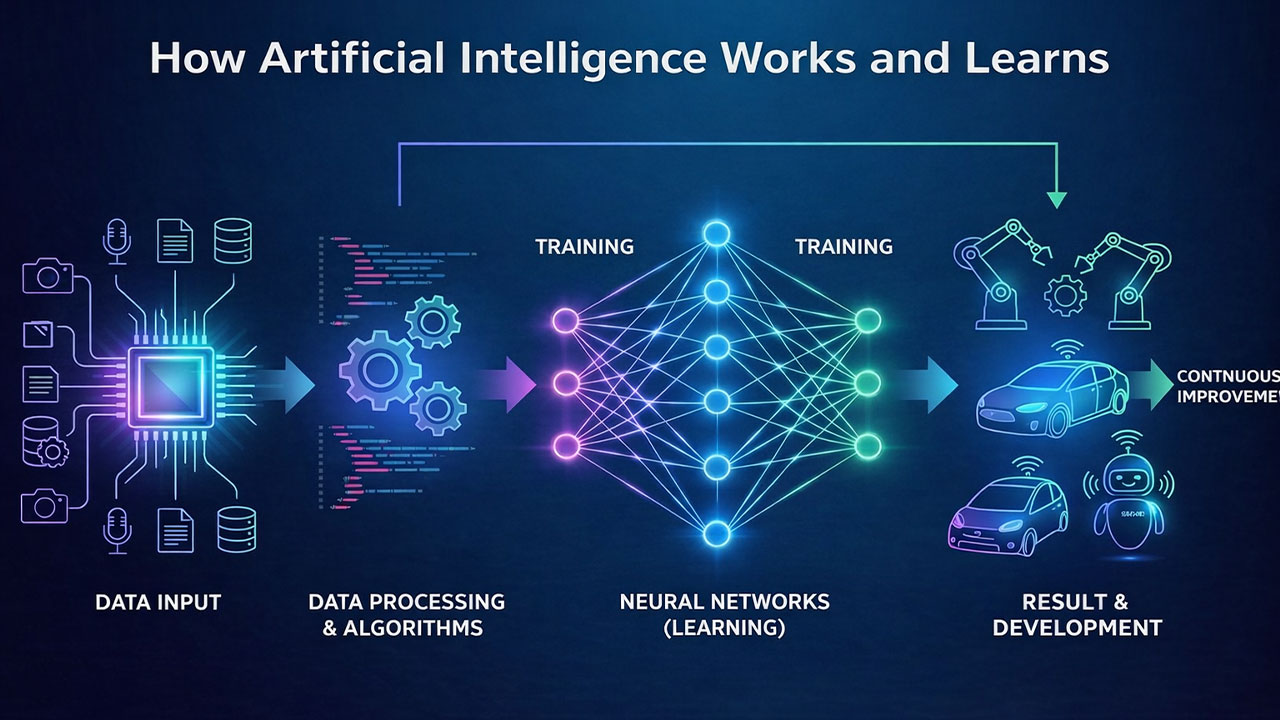
The core operating principle of artificial intelligence systems is based on processing massive data sets with advanced algorithms to reveal hidden relationships and patterns within that data. While computers analyze numerical data, images, or text, they run multi-layered mathematical computations in the background. This process begins by transforming raw information into a meaningful structure and forms the first step required for the system to recognize inputs.
The learning stage is the process in which the system discovers rules on its own by leveraging countless examples presented to it. In traditional software development, every step is coded by the programmer, whereas in this technology the machine is shown thousands of data sets and is expected to find commonalities. By analyzing correct and incorrect outcomes, algorithms automatically update their parameters so they can make more accurate decisions with each iteration.
Artificial neural networks, inspired by the neuron structure of the human brain, filter information through layers to deepen learning. When data enters the system, it passes through countless interconnected processing nodes, and each node focuses on a different feature of the data. Thanks to this layered architecture, the system can interpret everything from the simplest shapes to the most complex concepts in a hierarchical manner, enabling far more precise analyses.
The most critical point of the process—the feedback mechanism—ensures that mistakes return to the system as experience. When the model makes a prediction, the difference between the produced result and the expected real value is calculated, and the system readjusts itself to minimize this deviation. As this loop is repeated millions of times, the error rate drops to a minimum level and a reliable model structure emerges.
Once training is complete, the system gains the competence to interpret new data it has never encountered before. Based on acquired experience and constructed mathematical models, real-time inputs from the real world are processed within seconds and actionable outputs are delivered. In this way, instead of a static data repository, a dynamic intelligence structure is achieved—one that continuously improves and can adapt to new situations.
Core Types of Artificial Intelligence Used Today
Intelligent technologies are not evaluated within a single mold; rather, they are divided into different categories based on their capabilities and areas of use. The working logic and capacity of software that defeats a chess grandmaster are not the same as those of a digital assistant that chats with you in natural language. The systems we actively use today and place at the center of our lives are generally specialized structures designed to perform specific tasks. These mechanisms, which produce targeted solutions for specific needs, are classified as follows according to their functionality and data-processing capacity:
- Narrow AI (ANI): Almost all smart applications we see around us today fall into this group. Technologies such as Siri or Google Assistant are designed solely to perform a specific task they were coded for. Unlike human intelligence, they cannot reason outside their domain; however, they can demonstrate superhuman performance and speed within defined tasks.
- Generative AI: This type, which has gained popularity recently, does not only analyze data, but also creates new content based on what it has learned. By mimicking creativity-driven processes—from writing text to designing visuals—these models have revolutionized digital content production.
- Limited Memory: Used in systems that must make instant decisions, such as autonomous vehicles, this technology stores past data in memory for a short period to plan future actions. When making decisions, it considers not only the present moment but also recent experiences, producing safer and more consistent results.
- Reactive Machines: At the most basic level, these systems do not remember the past or learn from experience. They simply make the best programmed move based on the current situation. IBM’s famous chess computer Deep Blue is the best-known example of this type, responding to an opponent’s move with the most logical counter based on the board position at that moment.
Each of these types aims to make daily and professional life easier by completing a different part of digital transformation. Although for now we mostly interact with systems that flawlessly carry out defined tasks, the technology world continues its efforts without slowing down to reach a general intelligence capable of reasoning like humans. Understanding the limits of existing tools and grasping which system solves which problem is the most important step in developing the right strategies and increasing efficiency in the digital world.
The Impact of Artificial Intelligence on Digital Marketing and Web Design
In the digital world, the rules of competition are being completely rewritten with the introduction of intelligent algorithms. While marketing strategies now rely on precise data analysis rather than intuitive guesses, web design is also moving beyond static showcases into interactive experience spaces. This technology enables brands to personalize communication with their target audiences and offer a journey tailored to each user.
On the marketing side, insights obtained by processing massive data sets ensure that advertising budgets are used in the most efficient way. With machine learning, it becomes possible to predict potential customers’ behaviors in advance and reach them at the right time through the most suitable channel. As a result, broad, generic campaigns carried out blindly give way to pinpoint initiatives focused on the audience most likely to purchase.
In design processes, artificial intelligence places not only aesthetics but also user experience at the center. Systems that monitor visitors’ on-site movements in real time optimize the interface—from menu placement to color choices—boosting conversion rates. With tools that reduce the coding burden, designers can spend more time on creative work and brand storytelling instead of being overwhelmed by technical details.
Automation solutions spanning from content creation to customer support help maintain an always-on brand presence around the clock. Advanced chatbots with natural language processing capabilities answer website visitors’ questions instantly, eliminating waiting times. In addition, dynamically changing content recommendations based on users’ past preferences increase time spent on site and contribute positively to organic traffic.
As search engines become increasingly intelligent, SEO efforts are no longer limited to simply placing keywords; they are evolving toward semantic coherence and understanding user intent. In this new era, businesses that align with algorithms and integrate technology into their strategies increase digital visibility and move ahead of competitors. Success now lies not only in offering a good product, but in presenting that product to the right audience through the power of intelligent systems.
Popular AI Tools That Accelerate Business Processes
In the business world, time management and productivity have become not just goals but rules for survival. Professionals rely on intelligent assistants to focus on strategic decisions instead of losing time on routine tasks. These software solutions reduce operational workload across many areas—from content creation to data analysis—allowing employees to use their potential at the highest level. Here are the leading technologies that fundamentally transform office workflows and take productivity to the top:
- ChatGPT: Works like an advanced virtual assistant for answering all kinds of text-based questions, writing code, summarizing content, and generating creative content ideas, minimizing research and writing time.
- Midjourney: Turns just a few words of written prompts into high-resolution, artistic visuals, enabling designers to compress visual creation processes into minutes.
- Jasper: Developed especially for marketing professionals, this tool quickly creates blog posts, ad copy, and social media content in a tone aligned with the brand voice.
- Zapier: Connects thousands of applications you use, eliminates manual data entry, and turns repetitive workflows into an automated chain reaction.
- Grammarly: Goes beyond correcting grammar mistakes in written communication by analyzing tone and helping produce more persuasive and professional emails or reports.
- Canva (Magic Studio): Makes it accessible and fast for everyone to create presentations, logos, and social media visuals with AI support—without requiring graphic design expertise.
These platforms are not merely supporting tools in companies’ digital transformation journeys; they serve as fundamental engines of growth. When the right tools are integrated into the business model, costs decrease while the quality and speed of work increase noticeably. Incorporating technology into business processes is no longer a matter of preference; it has become a mandatory strategic move for any organization that wants to stand out under competitive market conditions.
The Most Distinct Differences Between Artificial Intelligence and Human Intelligence
Comparing machine learning and the biological mind is not limited to processing speed or data storage capacity. While computer systems process and finalize given data with flawless mathematics, the human mind approaches events with emotional depth, intuition, moral values, and social awareness. Although technology has long surpassed humans in raw computing power and data scanning speed, abstract abilities such as consciousness, originality, and contextual understanding still remain uniquely human strongholds. These two types of intelligence are not rivals, but mechanisms with very different skill sets that complement each other. The key points of divergence between the two structures are as follows:
- Processing Speed and Data Analysis: Artificial intelligence can scan and extract meaningful patterns from millions of lines of data within seconds, whereas the human brain—due to biological limits—needs much more time to process information at that scale.
- Emotional Intelligence and Empathy: Humans consider the other party’s feelings, social dynamics, and empathy when making decisions; machines operate only with logical data and statistical probabilities and have no ability to feel or perform moral self-assessment.
- Creativity and Originality: Software can remix existing data to create impressive derivatives, but humans can produce abstract concepts, artworks, or philosophical ideas that have never existed before through imagination and intuition.
- Fatigue and Performance Continuity: Digital systems can operate 24/7 without performance decline as long as there is energy, while biological bodies require regular rest, sleep, and breaks to sustain focus.
- Flexibility and Initiative: Human intelligence can take initiative and improvise solutions in uncertain, chaotic, or never-before-seen situations, whereas artificial intelligence generally struggles to go beyond pre-defined rules and its training set.
While the mathematical superiority of silicon-based systems is indisputable, this does not eliminate the unique value of the human mind. On the contrary, delegating routine, dangerous, or attention-intensive computations to machines enables humans to focus on higher-level cognitive activities such as strategic thinking, leadership, and complex problem solving. The ideal working order of the future will be built not on conflict between these two forces, but on a hybrid model where machines’ flawless speed merges with human intuition and judgment.
What Awaits Us in the Future: Will Artificial Intelligence Eliminate Jobs?
Throughout history, technological advances have always sparked both concern and curiosity in labor markets. The rise of today’s automation systems is triggering a similar transformation by fundamentally changing the definition of certain professions. Rather than creating a mass wave of unemployment as often assumed, this shift is moving the nature of human labor from physical and routine tasks toward cognitive and strategic domains. While repetitive duties based on muscle power or simple data entry are delegated to machines, the competencies expected from employees are being reshaped around creativity, empathy, and complex problem solving.
In the future work model, a strong collaboration—not competition—between humans and machines is anticipated. The use of intelligent assistants by doctors when making diagnoses, by engineers when designing, or by legal professionals when scanning precedents will raise professional standards. In this new era, it will not be those who reject technology, but those who integrate it into their processes to increase efficiency, who will remain resilient. Therefore, career planning will no longer be supported by technical knowledge alone; the ability to manage digital tools will become the most critical criterion.
This major wave brought by digitalization will replace some disappearing job titles with entirely new fields of specialization that were previously unheard of. The need for skilled human resources in areas such as data labeling, algorithm auditing, or system ethics will increase day by day. This evolution in the business world requires employees to keep themselves continuously up to date and adopt a lifelong learning philosophy. Ultimately, technology does not completely eliminate professions; rather, it transforms them and opens new doors where human intelligence can be used more effectively.




Do Comment