
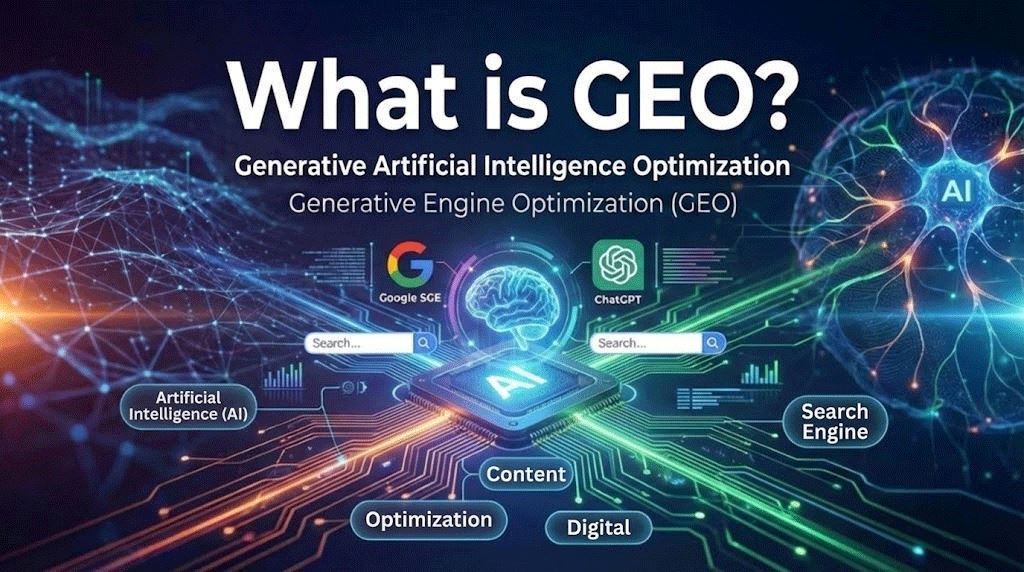
GEO, or Generative Engine Optimization, refers to the full set of strategic efforts applied to increase the visibility of your website and digital content in AI-powered search engines. Unlike traditional SEO techniques, this new discipline aims not only to rank highly on search engine results pages (SERPs), but also to have AI models such as ChatGPT, Gemini, or Perplexity recognize your content as a trustworthy source and cite it directly to users. Since users now interact with systems that deliver direct answers instead of clicking blue links, positioning your digital presence among the sources these smart algorithms “recommend” and “quote” is one of the most critical steps in modern marketing.
In this era of fundamental change in search behavior, optimization processes must appeal less to the technical crawling logic of bots and more to the comprehension and synthesis capabilities of answer engines. While classic search engines function like signposts that point you toward information, GEO-aligned systems act like assistants that process and present that information. For this reason, ensuring the accuracy of the information you provide, supporting it with original data, and addressing topics in depth rather than superficially helps AI perceive you as a competent authority. Instead of focusing solely on keyword density, delivering clear and structured information that fully satisfies user intent is the key to getting ahead in this new competitive landscape.
Success in this process is measured by having your brand or content presented as a primary information source within AI-generated answers. Visual optimization, quotability, and brand awareness play a major role in whether algorithms prefer you. In this new phase of the digital world, it is not enough for your content to be readable only by humans; it must also be easily crawlable, verifiable, and synthesizable by machine learning models. Building your strategy around metrics of being “selected” and “recommended” by AI—rather than click-through rates—is essential to remain present in the future of search experiences.
What Exactly Is GEO (Generative Engine Optimization)?
GEO covers all technical improvements implemented to help AI-based systems better understand, process, and cite digital content as a reference. Because users no longer see only lists of links when they search, but instead encounter synthesized answers, optimization strategies are evolving accordingly. This new approach aims for your brand or the information you provide to be perceived as a reliable source by generative models such as ChatGPT, Gemini, Copilot, and similar systems.
Unlike classic search engine optimization, the focus here is built around being recommended rather than ranking. It is not enough for bots to crawl your site technically; the accuracy, depth, and structure of the information you provide must be considered valuable by algorithms. Giving your content an authoritative tone and including clear data significantly increases the likelihood that AI will choose you as a primary information source and present you to users.
A successful implementation requires optimizing content not only for people, but also for machine learning models. Using statistical data, expert opinions, and quotable sentences is among the most effective ways to attract the attention of these systems. Presenting information in a clear, structured format—rather than through complex and indirect narration—makes it easier for algorithms to analyze data and return it to users as an answer.
Sources that fully satisfy user search intent and cover the topic from every angle gain a major advantage in this new era. Instead of superficial information, texts that get to the core of the subject and provide direct value to the user build authority much faster in the eyes of AI. Platforms that send trust signals and offer an original perspective become indispensable reference points for generative answer engines.
To exist in the future of digital marketing, adapting early to this transformation is critically important. It is no longer enough just to be visible; becoming the primary channel that delivers the information strengthens your brand’s digital reputation. Moving beyond traditional methods and aligning your content with the language and logic of generative engines will help you secure a lasting position in competition.
What Are the Key Differences Between SEO and GEO?
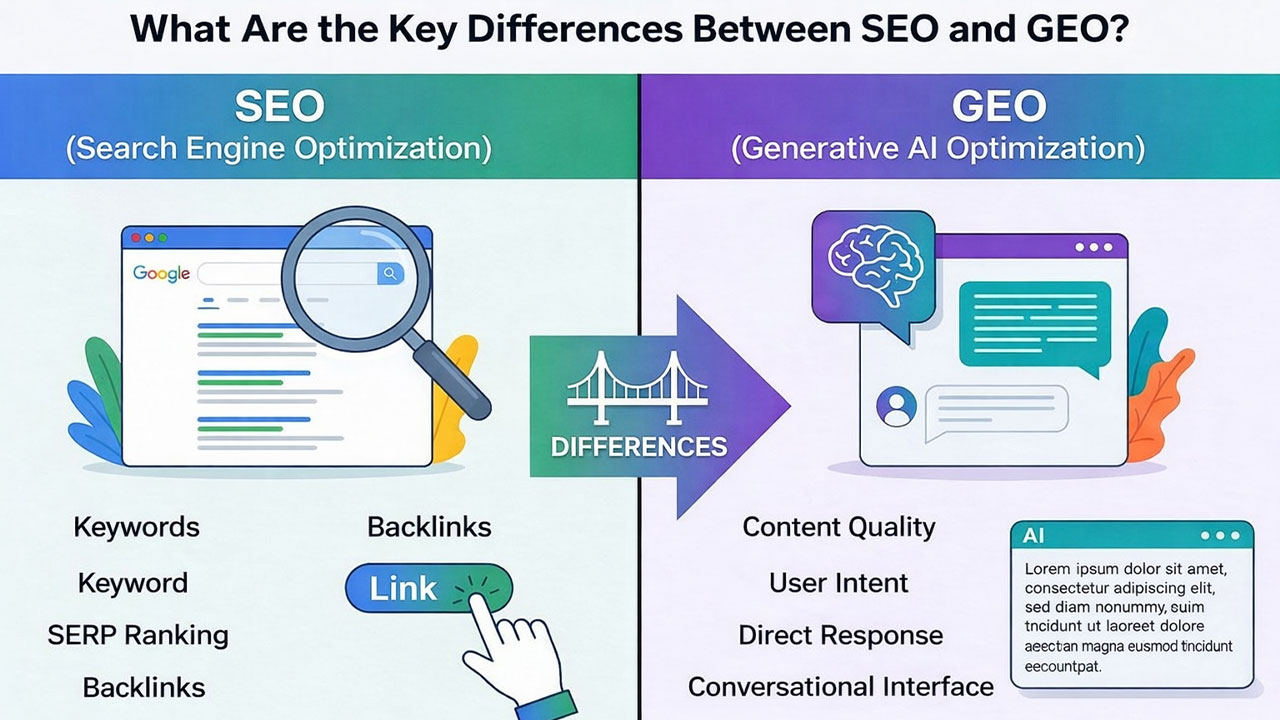
Although traditional search engine optimization and generative engine optimization serve the same fundamental purpose, they are separated by sharp lines in terms of the rules of the game and the intended outcome. One aims to bring visitors to your website by placing you at the top of rankings, while the other focuses on making you a reliable component of the direct answer that AI presents to users. The differences between these two disciplines stem from a fundamental shift in how algorithms process data and deliver it to users.
- In SEO, the primary goal is to rank high on results pages and earn clicks, whereas in GEO the aim is to be selected and cited by AI as a reliable source.
- In classic optimization, keyword density and backlink profiles are at the forefront, but generative engines place greater importance on content authority, semantic consistency, and a structure suitable for quotation.
- Search engines act as intermediaries that direct users to information, while AI models synthesize information and present it to the end user as a final, direct answer.
- SEO success is typically measured through organic traffic, bounce rate, and ranking tracking, whereas GEO performance is analyzed through brand visibility, frequency of inclusion in answers, and recommendation rates.
- Technical infrastructure and site speed are indispensable criteria for SEO, while GEO prioritizes the freshness and accuracy of data in the content and how comprehensively the topic is addressed.
To protect and strengthen your digital presence, the most accurate approach is to see these two concepts not as competitors but as complements. In the internet world of the future, it will not be enough merely to be visible; you will also be expected to hold an authoritative position that presents information in the most accurate and understandable way. In this transformation process, brands that blend traditional methods with the semantic integrity demanded by modern algorithms will be the ones that change the course of competition.
How Do You Optimize Your Website for AI Answers?
The first and most important rule for being referenced by AI systems is ensuring that the information on your site is indisputably reliable and accurate. When creating content, you should focus not only on writing text, but also on providing data verified by subject-matter experts. Citing sources, sharing up-to-date statistics, and highlighting author authority help algorithms place your site higher in the information hierarchy and view it as a trustworthy harbor.
Technical configuration and data markup languages play a vital role in helping bots interpret your content. Using schema markup and a properly designed hierarchical heading structure helps the machine easily crawl and categorize the information you provide. Summary information presented in bullet points—rather than complex paragraphs—makes it easier for AI to prefer your site, process your data, and generate fast answers to user queries.
Avoiding complex sentence structures and adopting a style that delivers clear and direct information significantly accelerates the optimization process. Summarizing the answers users seek in the introduction and then expanding with details aligns perfectly with how generative models operate. Concise, outcome-oriented texts free from unnecessary wording make it far more practical for systems to analyze and synthesize data and present it to end users.
Providing original analyses and brand-specific insights rather than generic information is one of the factors that helps you stand out in competition. Sharing interpretations distilled from your own experience—beyond standard definitions—turns your content from something that can be copied into a source that can be referenced. AI consistently prioritizes high-quality sources that offer a fresh and distinct perspective over information repeated thousands of times online.
You should leave behind outdated keyword-focused approaches and develop a natural, fluent narrative style closer to conversational language. Integrating the natural phrases and definitions people use in daily life into your content increases visibility in voice searches and chat-based queries. Texts built with semantic coherence allow algorithms to understand and associate context much more effectively.
Including short, impactful, and quotable sentences in your content encourages AI to pull excerpts directly from your site when generating answers. Presenting key definitions or conclusions in a prominent format helps algorithms recognize these parts as summary knowledge snippets. These “capsule” formats are among the most favored and frequently used data structures by digital assistants.
Criteria Required for AI Engines to Cite Your Content as a Source
AI models want to be confident in the accuracy and reliability of the information they present to users. For this reason, they prioritize sources backed by real expertise and verifiable data rather than random blog posts. For content to be referenced, it is not enough to simply describe a topic; it must also prove its authority on that topic through technical and editorial quality. Algorithms process information more confidently when they can verify the source and when data is clear and structured, turning it into answers without hesitation.
- Authority and Expertise (E-E-A-T): It should be clearly stated who wrote the content, and the author’s competence on the subject should be presented transparently.
- Original Data and Analysis: Sharing your own research, case studies, or statistical data—rather than copying other articles—positions you as a primary source.
- Use of Structured Data (Schema): Technically tagging the content makes it easier for bots to understand what the text is about and which questions it answers.
- Quotable, Clear Statements: Using short and definitive definitions that capture the essence of the topic encourages AI to use your sentences directly when forming answers.
- Source Citations and Verifiability: Supporting your claims with reliable external sources or scientific data increases your content’s accuracy score.
- Content Freshness: Keeping information up to date and revising it regularly helps systems tag you as the most current source of information.
Meeting these criteria means delivering a higher-quality experience not only for bots, but also for your readers. AI makes selections by following the most human-like and trustworthy logic and sets its references accordingly. Therefore, you should build your strategy not on technical tricks, but on producing high-quality work that truly adds value and fills information gaps. When you shape your digital footprint to these standards, it becomes impossible for algorithms to ignore you.
GEO Strategies: Ways to Increase Citation and Recommendation Rates
In the digital ecosystem, the new currency of visibility is being cited by AI. For your content to rise above billions of data points and become the primary source of an answer depends not on chance, but on strategic construction. Generative engines prefer sources that offer data-driven and clear propositions rather than vague or generic statements. For this reason, you should build your strategy not only to be read, but also to be perceived as a verifiable unit of knowledge by machines. Tuning your brand voice to a frequency that algorithms trust is one of the most fundamental factors that directly impacts your recommendation rate.
- Original Research and Statistics: Publishing your own data, survey results, or industry reports elevates you to an irreplaceable primary source.
- Niche-Focused Depth: Instead of getting lost in broad topics, creating the most comprehensive and detailed guide in a specific area reinforces your authority in that niche.
- Capsule Knowledge Format: Using lists or tables that summarize complex processes step by step in simple language makes it easier for AI to extract and use your data.
- Creating Brand Terms: Naming your methodologies or approaches gives you ownership when those concepts are searched or explained.
- Expert Quotes: Including insights from leading industry figures or academic references increases the credibility and weight of the text.
Applying these methods consistently turns your digital footprint into an indispensable knowledge pool for AI models over time. Your goal should be to provide the most satisfying and complete answer so the user does not need to ask a follow-up question. Algorithms “remember” content that satisfies users and clearly resolves uncertainties, and they surface it again and again for similar queries. Ultimately, citation success is not a technical trick; it is directly proportional to the quality and accessibility of the value you provide.
Can You Not Succeed in GEO Without SEO? How True Is That?
Although GEO and SEO may be perceived as two separate disciplines, in reality one functions as the life-support unit that enables the other to breathe. AI models do not generate information out of nothing; they learn by processing data that already exists on the internet and is crawlable and accessible. If a website is not indexed by search engines or is not visible in organic results, it becomes almost impossible for generative algorithms to discover that site as well. For a platform with weak technical infrastructure, a poorly structured sitemap, or blocked access for search bots, being referenced by AI contradicts the technical workflow.
When large language models build their training sets, they use the most reliable, authoritative, and accessible sources on the internet as a core data pool. Organic visibility and ranking success achieved through search engine optimization send a powerful signal to AI systems that the source is valuable. Ranking highly in search results not only helps your content reach people, but also increases the likelihood of being included as a priority in training data sets. Pages with strong semantic structure and high crawlability accelerate bots’ comprehension processes and form the foundation of GEO success.
Ignoring classic optimization processes and aiming only to appear in generative engines is no different than trying to build a structure on land with no foundation. Your consistent presence in organic search results is the most tangible proof of your identity and authority in the digital world. AI assistants avoid taking risks when presenting answers to users and prioritize sources that have proven themselves—those with traffic and those effectively “approved” by search engines. Therefore, the success and sustainability of GEO strategies can only be achieved by building them on top of a flawlessly operating SEO mechanism.
What Is GEO-Supported SEO Service?
Get in Touch for GEO-Supported SEO Service
If you are looking for professional digital solutions for your project, contact us today.
📞 0(232) 486 10 95 | 0(850) 885 02 62 | +90 (216) 599 03 78
GEO-supported SEO service is a holistic digital marketing approach that combines classic search engine optimization with next-generation AI standards. In this process, your website is optimized not only for Google rankings, but also aligned with the reference infrastructure of generative models such as ChatGPT, Gemini, and Copilot. The goal is to make your brand visible in traditional search results while positioning it as a primary source of information in AI-assisted answers.
Its operating principle is based on implementing technical SEO criteria flawlessly while presenting content in a format that machine learning algorithms can understand. Outdated tactics focused on keyword density are replaced by a semantic structure that explores the topic in depth and resolves uncertainties with clear data. Specialized schema markups and structured data optimizations are introduced so that AI bots can easily parse and present information while crawling your site.
As search habits change in the digital world, users now demand direct answers rather than searching for links. Brands that adapt to this shift gain a major competitive advantage by getting their services or products into the recommendation lists of digital assistants. This hybrid service ensures that businesses not only protect today’s traffic, but also continue to exist as an authoritative voice in the search experience of the future.
This authority-building strategy positively impacts conversion rates by increasing the quality of visitors coming to your site. Users approach sources that are approved and recommended by AI with far greater trust. By strengthening your brand’s digital reputation, this approach helps you achieve a resilient and sustainable growth momentum against technological change.



Do Comment